Most AI projects don't fail because the technology is bad. They fail because nobody double-checked whether the AI was actually measuring the right thing.
Here's the pattern we see over and over, across every industry: a team builds an AI model, runs it through hundreds of test configurations, and picks whichever version scored "best" on some internal technical measurement. It looks great in testing. Then it goes live, and it quietly stops delivering real value — not because it broke, but because "best" was never actually defined the right way.
The model wasn't being graded on the thing that mattered. It was being graded on a proxy for the thing that mattered. And nobody checked if those were the same thing.
A Real Example — From Our Own System
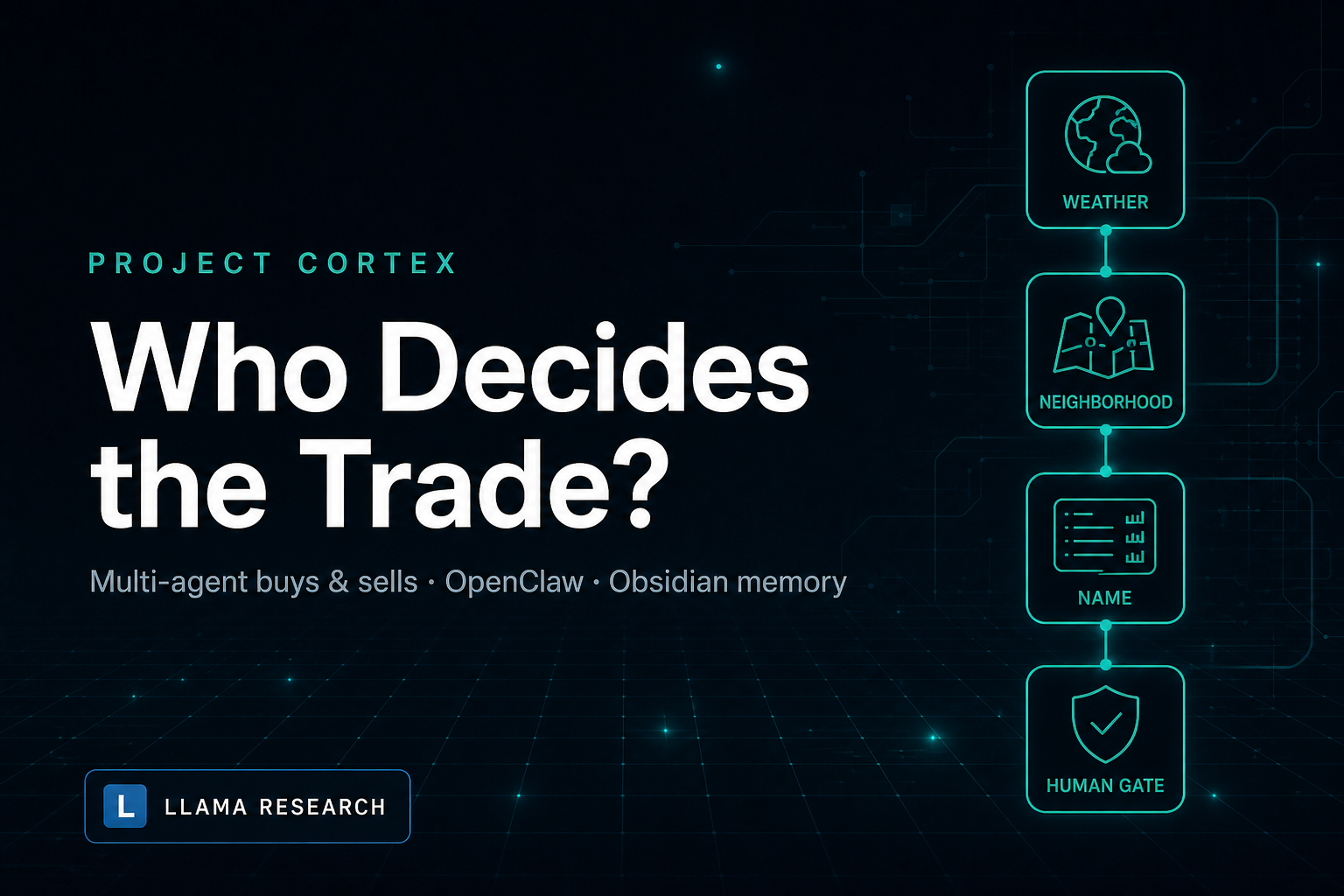
The clearest case we can describe in full is one where we were both the builder and the customer: Project Cortex, our own multi-agent decision platform. It runs in a simulated environment with no live exposure, which is exactly why we can be specific about what went wrong inside it.
We ran a large automated search — over 100 different versions of a predictive model — each one scored against a single technical benchmark. The "winner" was clear. Standard practice would be to ship it.
We didn't ship it.
Instead, we took the top handful of candidates and independently graded them a second time — this time against the measures that actually reflected real-world value, not the technical scoring the system used to pick its own favorite.
The system's own top pick came in dead last on every measure that mattered. Three other candidates — ones the automated search had ranked lower — were actually the better choices.
That's not a hypothetical. That's what happens when you let a system grade its own homework and trust the result without a second opinion.
To be clear about whose result that is: this is our own operating history, not a client outcome. We describe client engagements only with their approval.
Our Approach: A Process, Not a One-Time Build
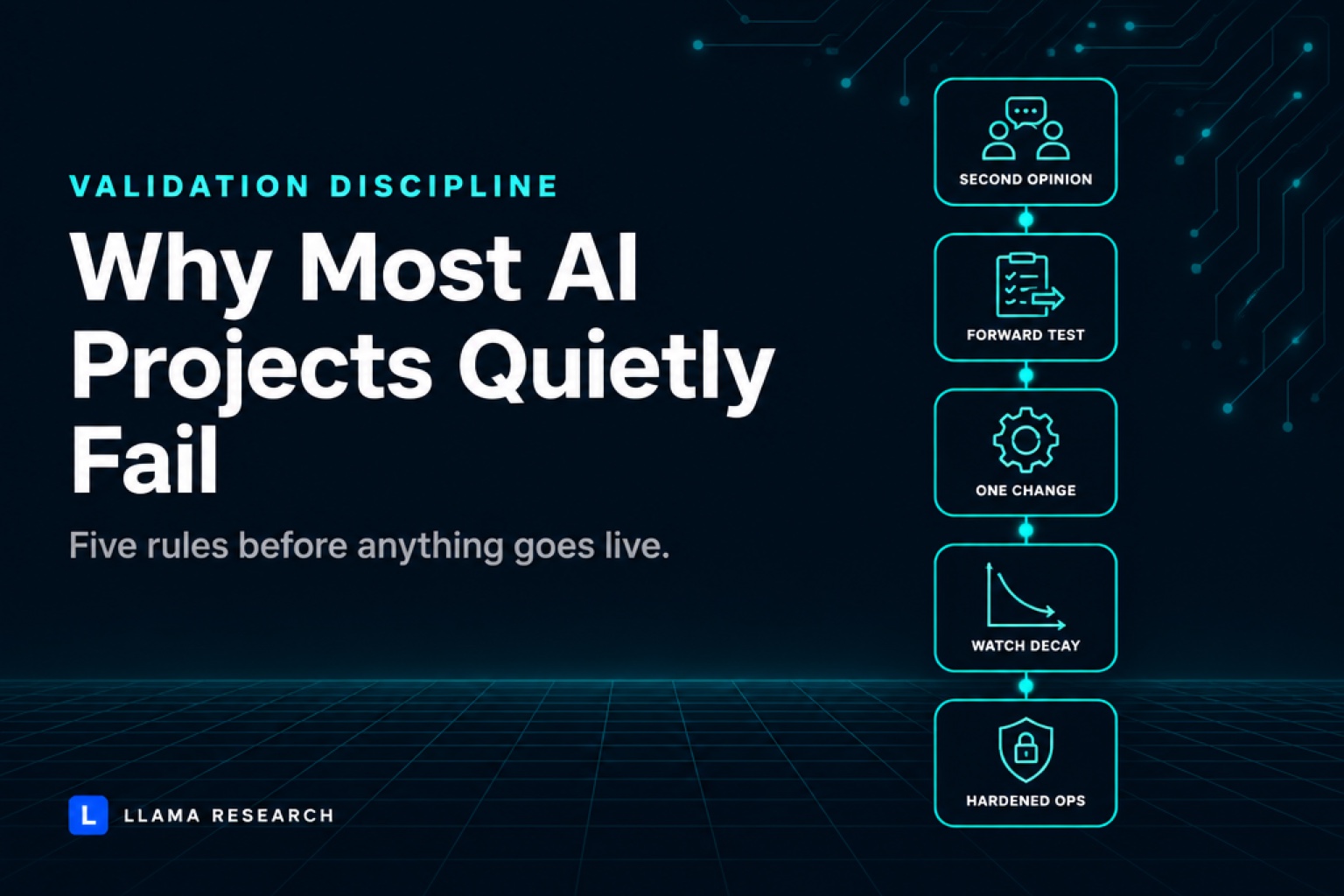
We don't treat AI delivery as "build one model, hand it over, done." We treat it as an ongoing, repeatable process — a disciplined way of finding, testing, and maintaining useful predictions in any set of business data. Five simple rules make this work.
1. Get a second opinion — always. Whatever an automated system picks as its "best" result, we independently check that pick against the outcomes that actually matter to the business. The system's own scorecard is never the final word.
2. Prove it on new data before trusting it. We never put a model into real use just because it performed well on historical data. Looking good on the past is easy — models can accidentally memorize old patterns that won't repeat. Before anything goes live, it has to prove itself on genuinely new data it hasn't seen, over a defined trial period. No exceptions, no matter how impressive the historical results look. We've described how this quality gate works inside a system that retrains itself.
3. Change one thing at a time. When we test a new idea — a new data source, a new signal — we test it completely on its own, compared against what we had before, and we write down exactly what happened. If we tested five new ideas at once and performance improved, we'd have no idea which one actually helped. So we never do that.
4. Watch for things going stale. Predictions that work today can quietly stop working as circumstances change — customer behavior shifts, conditions change, patterns move. We build automatic monitoring that flags when a model's accuracy is slipping, instead of letting it fail silently until someone notices by accident, usually too late.
5. Make sure the plumbing doesn't fail quietly either. None of this works if the systems underneath are unreliable. A small real example: a tool we use to track and compare every test result went down without warning for several hours, because it wasn't set up to recover on its own. We fixed that properly — it now restarts itself automatically — and we proved the fix by intentionally shutting it down and timing exactly how fast it came back online. The discipline has to cover the boring infrastructure, too, not just the model.
This Isn't Specific to Any One Industry
Here's the part we think matters most: none of the five rules above care what you're trying to predict.
The same process works whether a business wants to predict:
- Which customers are about to leave
- Which insurance claims look suspicious
- Which machines are about to break down
- How much demand to expect next quarter
- Which patients are at risk of returning to the hospital
- Where a supply chain is likely to break
What changes from client to client is the data itself and exactly what you're trying to predict. What stays the same is the process: gather options, get a second opinion on the "winner," test it on new data before trusting it, change one thing at a time, watch for decay, and never let anything go live without a person signing off.
We'll also be straightforward about something: how long it takes to properly prove a model varies a lot by situation. Some things can be validated in a couple of weeks. Others — like predicting a rare, slow-moving outcome — honestly take months before anyone can say with confidence that it's working. A partner worth trusting tells you that upfront, instead of promising the same speed for everything.
How This Connects to Everything Else We Do
This isn't a separate specialty for us — it's the same mindset behind everything we build:
- A person signs off before anything goes live. Same principle we apply across all of our AI work — automation proposes, a human approves. Most "human oversight" is theater, and we've set out what the real thing looks like.
- Everything is written down and explainable. Every test, every decision, every result — logged, so anyone can go back and see exactly what happened and why.
- We watch for things quietly breaking. Automatic monitoring, not "we'll notice if something seems off."
- We build on open tools, not closed boxes. We use established, widely-used open-source software rather than proprietary systems that lock a client in and can't be inspected. If a client ever wants to take something in-house, they can. Our decision framework for open source versus proprietary models sets out when each one wins.
What This Means If You're Considering Working With Us
You're not buying a single model or a one-time project. You're buying a process — one you can watch, question, and understand — that applies to your specific business and data, built on open tools instead of a black box, with a person checking every major decision along the way.
The process is the real value. Not any one prediction, not any one model — the discipline behind finding, testing, and replacing them as circumstances change.
If you have data and a business question you suspect it could answer, we'd like to talk about applying this same approach to it.