{{youtube:EPe5teiv6Eg|Watch: Project Cortex — autonomous multi-agent AI platform}}
From the Llama Research team
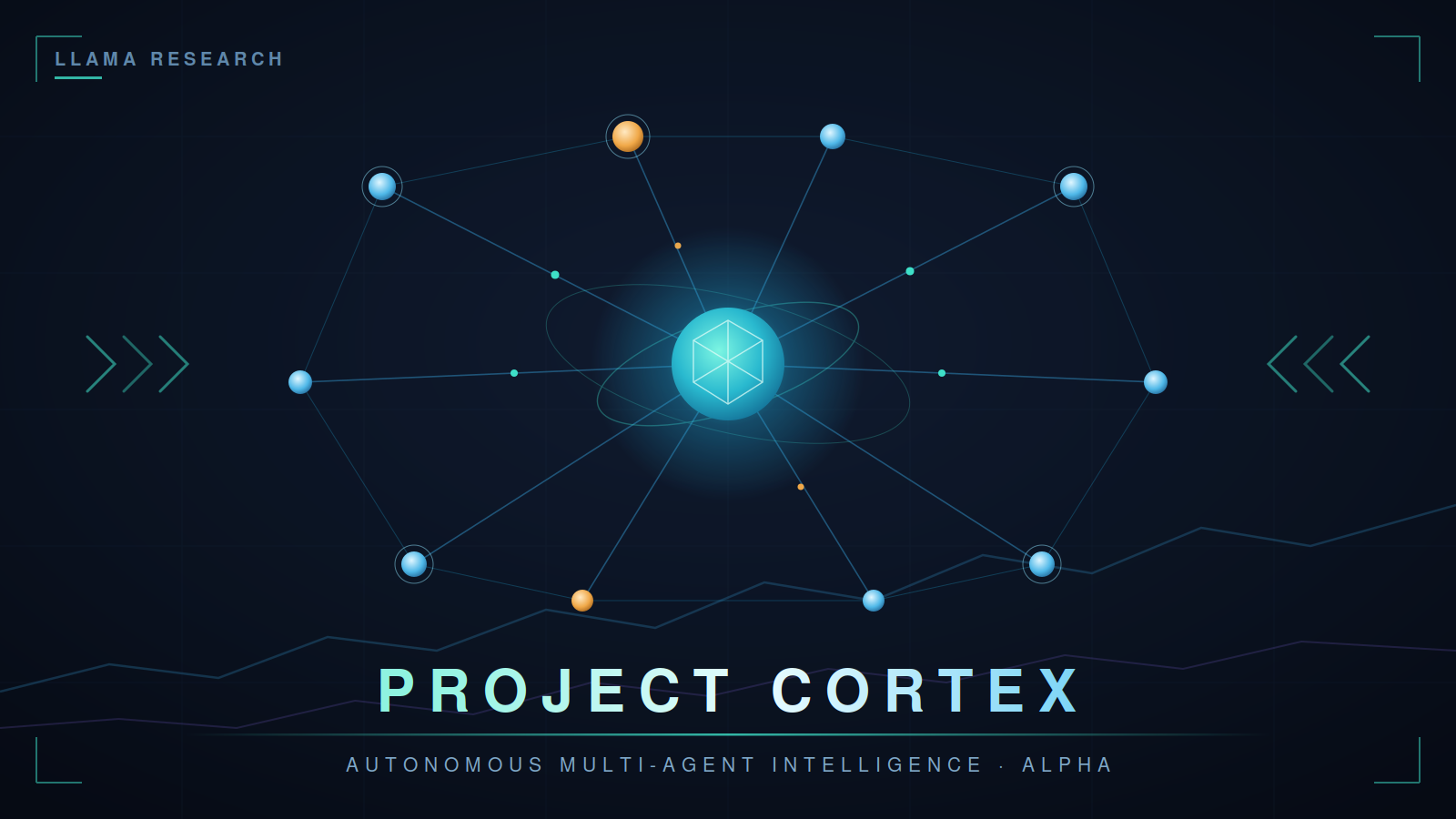
Most of what we do at Llama Research happens behind the scenes — inside other people's stacks, compliance reviews, and launches. Project Cortex is different: our proving ground for an autonomous multi-agent AI platform we run ourselves — currently in alpha, built for gated decisions, not demo theater.
This post is for CTOs, heads of engineering, and ops leaders weighing whether a multi-agent AI platform is ready for production. Same architecture can point at finance, government, or other high-stakes domains — as long as humans still own deploy.
Deep dives: how Cortex decides buys and sells · trading-desk anatomy
First, What Is a Multi-Agent AI Platform?
A multi-agent system is a group of specialized AI programs that divide up a complex job, coordinate with each other, and escalate to a human when it matters. Instead of one large model trying to do everything, each agent owns a narrow role — research, risk, execution, monitoring — and a supervising layer decides what actually happens. Done right, it's less like a chatbot and more like an org chart that runs itself, with a human-in-the-loop approach keeping people firmly in control.
Why We Built It
Most AI-in-production stories stop at a chatbot or a dashboard. We wanted to prove out something harder: a system that ingests real-world data, trains its own models, makes decisions, and acts on them — with humans firmly in control of every deployment step.
Project Cortex is our test bed for that. It's a disciplined, data-driven pipeline built to:
- Remove emotion and ad-hoc judgment from repetitive decision-making
- Enforce risk and governance rules mechanically, with no overrides without explicit human sign-off
- Learn from every outcome and feed that learning back into the system
- Operate continuously, so work keeps moving even when nobody's watching the screen
The Intelligence Core
At the center is a machine learning model that scores probability and confidence on a rolling basis. Its working universe today is S&P 500 stocks — tracking the constituents continuously so every signal is grounded in a liquid, well-covered equity set rather than a vague “the market.” It retrains on a nightly cadence, running against a broad set of price, volume, and macro-regime features, plus sentiment signals.
It doesn't get to update itself blindly. Every retrain has to clear a strict quality gate before it goes live. If it doesn't pass, the previous version stays in place. The system is never allowed to swap something proven for something untested — a core principle of sound model lifecycle management.
Nothing Moves Without Clearing the Gates
Every signal passes through a multi-layer gate stack before it becomes an actionable recommendation. Each gate can stop a decision cold:
- Signal quality — checks hit rate, freshness, and confidence threshold. A signal that's stale or below conviction never advances, no matter how attractive it looks.
- Macro regime check — reads broader market and rate-environment conditions, so the system doesn't act into a hostile backdrop it should be standing down in.
- Positioning check — reviews market posture and flow signals for crowding or fragility.
- Technical confirmation — requires momentum and structure to agree before committing.
- Event proximity — blocks new commitments too close to known event risk, where a single headline can invalidate the thesis.
- Pre-action preflight — runs a final real-time check immediately before anything executes.
Only what survives the full stack reaches a final decision card. This is the "fail closed" principle in practice: when in doubt, the system does nothing.
An Actual Org Chart of AI Agents
Project Cortex doesn't run as one monolithic model. It runs as a small organization of specialized agents, each with a defined role and schedule. We group them into three functions.
Strategic Direction
- CEO agent — the orchestrator that coordinates the whole system
- CIO — sets the daily directive and priorities
Research & Intelligence
- Macro Researcher — regime and macro conditions
- Sector Researcher — sector-level fragility and factor regime
- Event Sentinel — scans upcoming event risk
- Overnight Sentinel — watches for breaking developments around the clock
Operations & Risk
- Monitor — health watchdog running continuous checks
- Engineer — nightly maintenance
- Data Scientist — signal quality and model evaluation
- Execution Risk Agent — sizing and drawdown enforcement
One rule governs all of them, without exception: every agent can propose. Only a human approves and deploys. No agent touches production without explicit sign-off.
Execution, Built for Control
When something is approved, it executes as a single atomic action, with no partial or "legging" risk. A pre-action preflight runs automatically first.
Confirmation goes out within 60 seconds of execution. Every action is logged with a full fingerprint: signal score, confidence level, market conditions, and every flag that was checked. A high-water tracker enforces a hard drawdown circuit breaker, so the system's downside is bounded by design rather than by hope.
A System That Learns From Itself
Every outcome flows back into the pipeline:
- A forward-test ledger captures the ground truth of every call and its result
- Full context is captured at the moment of every action
- A weekly retro asks, honestly, what worked and why
- Directive history tracks whether high-confidence calls actually outperform over time
It's a closed loop. The system doesn't just act — it grades its own results and gets sharper because of it. This is MLOps discipline applied to decision-making, not just model training.
Built On Modern AI Infrastructure
Under the hood, Project Cortex runs a layered model stack: a specialized signal model for prediction, large language models handling the agent layer, and a locally-run open-weight model for lower-cost inference where it makes sense. Everything is orchestrated across a secure private network, with credentials managed through enterprise-grade secret management and full version control on every change.
The Principles Behind It
- Single source of truth — one canonical artifact per data type, no duplicated work
- Fail closed, not open — missing data means the system stands down, not that it takes a free pass
- Hierarchy with accountability — every directive logged and tracked, exceptions flow up
- Propose, don't deploy — no agent touches production without human sign-off
- Cost discipline — intelligent model routing keeps operating cost tightly controlled
These map closely to established AI governance and AI risk management thinking, including the human-in-the-loop and "map, measure, manage" principles at the heart of the NIST AI Risk Management Framework.
Where Things Stand
Project Cortex is currently in alpha testing on a simulated environment — real logic, real infrastructure, real data, and zero live risk while we validate performance and harden the system. Day to day, that means tracking S&P 500 stocks, scoring opportunities across the index, and running every candidate through the gate stack before anything is even proposed. Operationally, it runs 10 active agents across 40+ scheduled jobs, retrains its model nightly against a multi-check quality gate, and has held above 99% uptime since our infrastructure migration earlier this year.
What's Next
For the readers who made it this far — here's the roadmap:
- A live-deployment decision once alpha validation targets are met
- Additional agents, including a mirror model for downside signals and a dedicated compliance-review agent
- Published operational benchmarks as we move from alpha toward a controlled live pilot
- A follow-up post going deeper on the governance layer — how propose-don't-deploy works in practice, and where a human actually sits in the loop
Why We're Telling You This
We didn't build Project Cortex to prove a point about any one market. We built it to prove a point about execution: that a small, disciplined team can design, build, govern, and ship a genuinely autonomous multi-agent AI system — end to end, with compliance and risk controls baked in from day one rather than bolted on after.
That's the capability we bring to clients. Whatever your industry, the underlying pattern is the same: a decision pipeline buried in your operations that's still running on gut instinct, spreadsheets, or lagging reports, when it could be running on a governed, self-improving agent system instead.
If that's worth exploring, two of our services are the natural starting points:
- Blueprint — an honest audit of where you stand today: tech stack, data maturity, team readiness, and compliance exposure
- Cortex — the intelligence engine underneath it all: custom models, decision frameworks, and backtesting
Related reading from Llama Research
- Anatomy of a Multi-Agent Trading System
- The Private AI Imperative: Why Regulated Enterprises Are Abandoning Public AI APIs
- Open Source LLM vs Proprietary: A Decision Framework for Regulated Enterprises
See the full range of what we do at llamaresearch.ai, or reach us at hello@llamaresearch.ai.