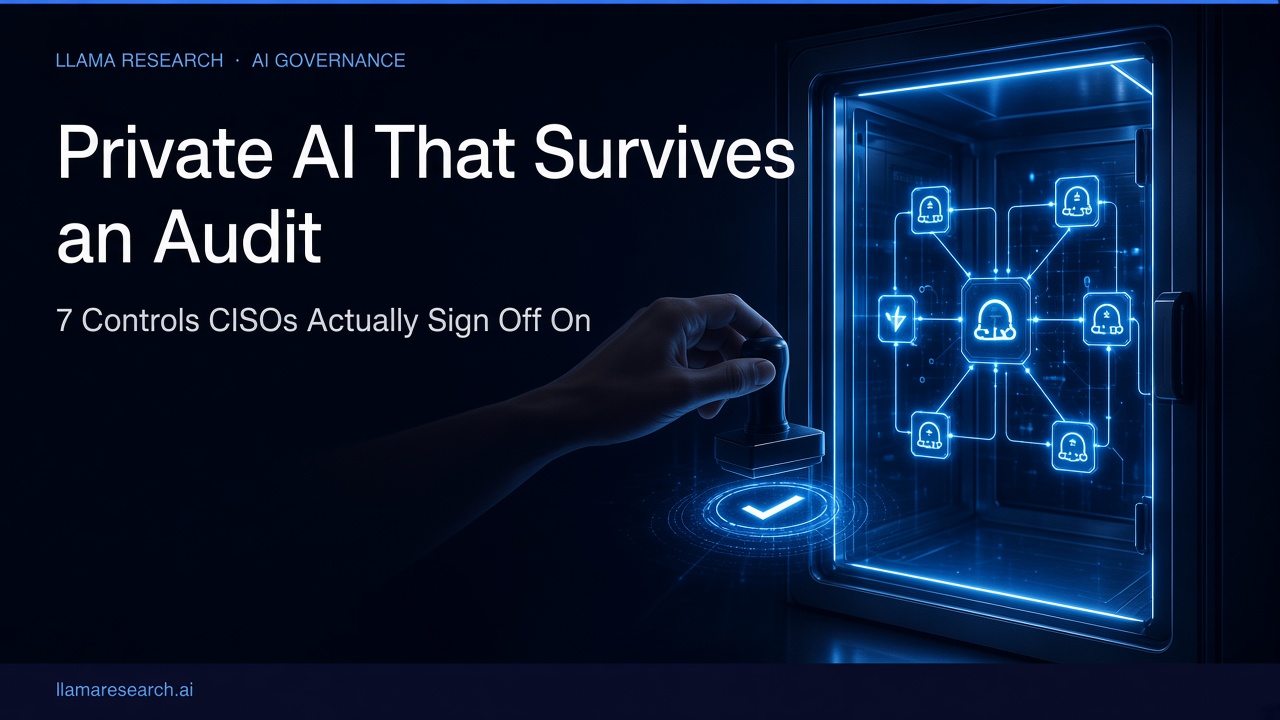
Most private AI pitches die in the security review.
Not because the model is weak. Because the CISO cannot answer a simple question under audit pressure: what can leave the boundary, who can change it, and how do we prove what happened?
Boards keep hearing "we deployed private AI." Security teams keep asking for the control narrative. Those are not the same conversation.
This is the private AI control set we see CISOs actually sign — not a vendor feature checklist, and not another essay on why public APIs are risky. If you already buy the private AI imperative, this is the next page: how private AI survives an audit.
What private AI must mean under audit
For a CISO in a regulated enterprise, private AI is not "we self-host a model."
It means:
- Sensitive prompts, context, and outputs stay inside a defined trust boundary
- Model and tool changes are governed like production software
- Human oversight is real, logged, and reviewable — not theater (HITL that boards can measure)
- You can reconstruct a decision path after an incident
If your deployment cannot support those four claims, security will stall it — correctly. The same bar applies whether you evaluate open-source vs proprietary LLMs or a full agent stack.
7 private AI controls CISOs sign off on
1. Data residency and egress you can prove
Control: Explicit allowlists for every network path the AI stack can reach. Default deny for model providers, telemetry endpoints, plugin marketplaces, and "helpful" auto-updaters.
What auditors ask: Show the egress map. Show blocked attempts. Show which environments can call which endpoints.
Fail mode: A "private" LLM that still phones home for embeddings, evals, or license checks — with no security-owned inventory of those calls.
2. Prompt and context classification
Control: Treat prompts and retrieval context as regulated data classes. Tag sources (customer PII, trading books, HR, legal holds). Enforce which classes can enter which model tiers.
What auditors ask: Can a support agent paste a customer file into a model that is not approved for that class?
Fail mode: One chat box for everything. Classification lives in a policy PDF nobody enforces at runtime.
3. Model and tool inventory (SBOM for AI)
Control: A living inventory of every model ID, version, host, fine-tune lineage, and tool/function agents can invoke — with owners and change tickets.
What auditors ask: What model answered last Tuesday? Which tools could it call? Who approved that tool?
Fail mode: Shadow agents on a laptop, undocumented MCP servers, or "we upgraded the model" with no diff in the change log.
4. Identity, least privilege, and non-human accounts
Control: Agents and orchestration services run as distinct identities. Secrets are short-lived. Tool permissions are scoped per agent role — not a shared god-token to the data warehouse.
What auditors ask: Map this agent to an identity. Show its entitlements. Show rotation and break-glass.
Fail mode: One service account that can read CRM, write email, and call the broker API "because the agent needs it."
5. Logging that reconstructs decisions
Control: Immutable logs for prompts (or redacted hashes where required), retrieved context IDs, model version, tool calls, outputs, and human overrides — with retention aligned to your industry.
What auditors ask: Walk us through a single high-risk decision end to end.
Fail mode: Chat transcripts in a vendor UI you cannot export, or logs that store secrets in cleartext and then get turned off.
6. Human-in-the-loop gates with metrics, not slogans
Control: Defined approval gates for high-impact actions (external send, money movement, access grant, production change). Queues, SLAs, and override reasons are measurable.
What auditors ask: When does a human have to act? What happens if they do not? How often are overrides used?
Fail mode: "A human is in the loop" with no latency budget, no reviewer load model, and no evidence the gate ever blocked anything. See our board metrics for what human-in-the-loop AI actually costs.
7. Incident response that includes the model
Control: Runbooks for prompt injection, data exfiltration via tools, poisoned retrieval, and compromised agent identities. Include kill switches: revoke tool scopes, freeze model versions, force human-only mode.
What auditors ask: Tabletop the scenario. Who turns it off? How fast? What is preserved for forensics?
Fail mode: Classic IT IR playbooks that never mention retrieval corpora, agent memory, or tool brokers.
Private AI audit scorecard (use this in reviews)
Bring these seven controls as a scorecard for any vendor or internal private AI project. For each control, demand:
- Owner (named role, not "the platform team")
- Evidence (config, log sample, ticket, diagram)
- Test (what you can break in a tabletop this quarter)
If a vendor answers with architecture poetry and no evidence artifacts, you do not have private AI. You have a demo.
FAQ: private AI audits for CISOs
Does self-hosting equal private AI?
No. Self-hosting without egress controls, inventory, and decision logs still fails most audits. Private AI is a control posture, not a deployment checkbox.
What do auditors ask first?
Usually egress and data residency, then whether you can reconstruct a high-risk decision (model version, tools called, human override).
How is this different from generic AI governance?
Governance policies state intent. These seven controls are what CISOs sign when private AI must survive an audit in production.
Where Llama Research fits
We design private AI systems so these controls are runtime properties, not slideware: boundary egress, governed tool access, auditable agent trails, and HITL gates that produce board-usable metrics.
If you are stuck between "the business wants agents" and "security will not sign," start with this private AI control set. It turns a vague debate into a review you can pass — or a gap list you can fund.
Next step: Map your current stack against the seven. The first empty row is your real roadmap.
Related reading: The Private AI Imperative · What Human-in-the-Loop AI Actually Costs · Open-Source LLM vs Proprietary for Regulated Enterprises