Most organizations building with AI hit the same ceiling. They prototype a research assistant, wire up a few API calls, stand up a dashboard — and then stop. The demo works. The pilot impresses. But nothing compounds.
That is the gap between a research platform and a governed AI factory — not NVIDIA's GPU-cluster marketing sense of "AI factory," but an ops system that produces decisions under propose-deploy rails and learns from outcomes.
What Is an AI Factory (for Decision Systems)?
A research platform answers questions. An AI factory for decision work continuously ships governed work product — research, recommendations, structured actions — with quality gates, human shipping authority, and feedback that compounds. Chatbots reset every session. Factories keep institutional judgment.
Inside Llama Research, our multi-agent research/decision stack started as synthesis tooling. It is evolving into a factory that ships daily and gets sharper from its own scrap and rework — transferable across finance ops, government, healthcare operations, industrial/energy, and cyber, as long as humans still own the deploy button.
Related: Project Cortex · HITL that isn't theater · AI agent ROI 30/60/90
What an AI Factory Actually Is
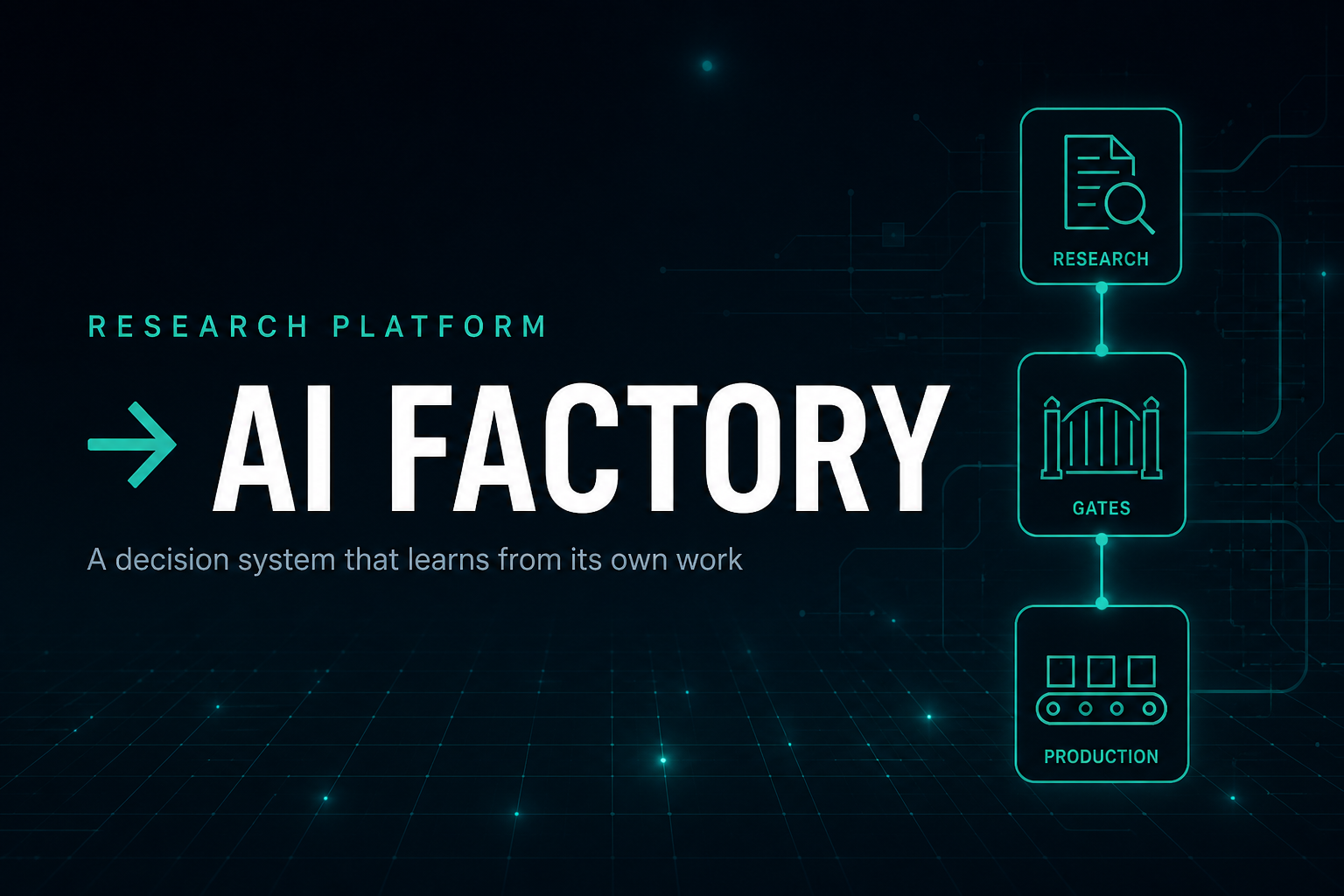
Borrow the metaphor from manufacturing. A factory has:
- Raw inputs — data feeds, signals, context, operator questions
- Production lines — specialized processes that transform inputs into outputs
- Quality assurance — checks, gates, and reviews before anything ships
- Shipping gates — human approvals that release outputs into the real world
- Scrap and rework — feedback loops that catch failures, log lessons, and feed improvements back into the line
An AI factory applies the same discipline to knowledge work. It doesn't just answer a question once. It continuously produces research, recommendations, and structured decisions — with governance at every stage and learning baked into the process itself.
This isn't a chatbot. It isn't a black-box autopilot. It's industrialized judgment under control.
The Arc: Research Platform to Governed Production System
The platform began as a multi-agent research stack. Specialized agents handled different domains — research synthesis, risk assessment, operational coordination, content generation. Each agent had a defined scope, clear inputs, and structured outputs.
That architecture still holds. The system has evolved in three important ways:
- From session-based to persistent. Memory and artifacts now survive across sessions. The system doesn't reset. Prior research, past decisions, and accumulated context form an institutional memory layer that agents draw from.
- From single-shot to continuous. Instead of answering one question at a time, ongoing processes monitor signals, update regime assessments, and surface changes that matter on a schedule.
- From static to self-improving. This is the hard part, and where the AI factory concept becomes real. Closed-loop feedback connects proposals to outcomes, scores results, and distills lessons that change future behavior.
The result is a system that gets better at its job the longer it runs — not only because someone retrains a model, but because the production process itself captures and applies what it learns.
How the Factory Learns
Self-improving AI is easy to overclaim and hard to build responsibly. Here's the approach, with the guardrails that make it viable for regulated environments.
Closed-Loop Feedback
Every material proposal follows a traceable path: proposal → human gate → execution decision → outcome logged → lesson distilled. Nothing consequential deploys without human approval. Once an outcome is observed, it feeds back into context for future proposals.
This isn't reinforcement learning in the traditional ML sense. It's structured outcome tracking — closer to how a well-run investment desk, policy unit, or ops center operates than how a neural network trains overnight.
Tagged Outcomes and Scored Lanes
Borrow a discipline you might call a "desk learning OS." Every decision gets tagged by category, domain, thesis owner, and confidence. Outcomes are scored by lane — which type of recommendation worked, which didn't, and why. You never blend unlike bets into one vanity score.
The rhythm matters too. Weekly review cycles distill at most one top lesson from the prior period. That lesson becomes a constraint the system respects in the next cycle. One Friday lesson, applied at entry the following week. Simple, repeatable, auditable.
Shadow vs. Production Separation
This is where governance meets learning. Maintain a strict separation between shadow research and production recommendations.
- Shadow lanes run experimental models, test new approaches, and log predictions — but their outputs never reach production without explicit promotion through a human gate.
- Production lanes remain recommend-only and human-gated. They don't act autonomously. Period.
That separation lets the system learn aggressively in shadow mode while keeping production outputs conservative and governed. Enterprise AI agents need this kind of architectural discipline. Without it, you're either too cautious to learn or too reckless to trust.
Memory and Artifacts as Institutional Knowledge
Most AI systems suffer from organizational amnesia. Every conversation starts fresh. Every analysis ignores what came before.
Treat memory as infrastructure. Research artifacts, decision logs, outcome records, and distilled lessons persist as structured context that agents can retrieve and reason over. The system builds institutional memory the same way a high-performing team does — except it doesn't lose people to turnover and it doesn't forget on Monday morning.
Rails That Keep Learning Safe
A self-improving AI system without governance isn't an asset. It's a liability. Hard rails:
- Propose, don't deploy. Agents generate recommendations. Named humans authorize. There is no autonomous action path in production for consequential work. We wrote about why most human-in-the-loop AI is theater if this boundary is soft.
- Fail-closed. If the system hits uncertainty, ambiguity, or conflicting signals beyond its confidence thresholds, it stops and escalates. It doesn't guess its way into a "ship it" default.
- Human veto sticks. When a human overrides a recommendation, that override is logged, respected, and incorporated into future context. The system doesn't relitigate vetoed proposals.
- Audit provenance on everything. Every recommendation carries a trace: which agents contributed, what data they used, what confidence they assigned, and what prior lessons influenced the output. In regulated environments, this is table stakes — not a nice-to-have slide.
These aren't aspirational principles. They're architectural constraints enforced at the system level.
Same Factory, Different Production Lines
The rails travel. The production line is what changes.
An AI factory is not a finance-only pattern. Anywhere an organization must turn messy inputs into governed recommendations — under audit pressure, with humans still owning the decision — the same machine applies. Only the raw materials and the named approvers change.
Use the same four-step skeleton in every vertical: inputs → proposal → human gate → tagged outcome + weekly lesson.
Financial services (risk, ops, research)
- Inputs: policy manuals, exception queues, research packets, market/ops context, prior decisions
- Proposal: exception disposition, research memo outline, control check, escalation package
- Human gate: desk head, risk officer, compliance reviewer — agents propose, humans deploy
- Learning: tag by product line and decision type; score lanes separately (ops vs research vs control); one Friday lesson becomes next week's entry filter
This is governed judgment at volume — not autopilot trading, and not a chatbot bolted onto a PDF.
Government and public sector
- Inputs: case files, constituent requests, procurement packets, policy drafts, prior rulings
- Proposal: briefing package, case triage recommendation, procurement risk flags, draft response for official review
- Human gate: named official or program owner; fail-closed if no authorized reviewer is available
- Learning: tag by program and decision class; log overrides; weekly lesson on recurring exception types (not a vanity "cases closed" metric)
Here the factory's value is diligence-ready provenance as much as speed. If you cannot reconstruct who approved what and why, you do not have a production system — you have a demo.
Healthcare operations (not clinical diagnosis)
- Inputs: schedules, claims queues, documentation backlogs, payer rules, staffing constraints
- Proposal: scheduling optimization, claims routing, documentation QA flags, prior-auth packet assembly
- Human gate: operations lead or authorized clinical-ops role before patient-facing or payment-facing changes go live
- Learning: score by workflow lane (scheduling vs claims vs docs); track rework rate and escalation quality; weekly lesson on the failure mode that burned the most human hours
Keep the boundary sharp: operations automation under governance is in scope. Autonomous clinical diagnosis is not the point of this pattern.
Industrial and energy operations
- Inputs: sensor summaries, work orders, incident logs, vendor performance, maintenance history
- Proposal: maintenance prioritization, incident brief, vendor-risk flag, outage playbook draft
- Human gate: plant/ops manager or reliability lead before fieldwork or external commitments
- Learning: tag by asset class and incident type; separate score for "caught early" vs "false escalate"; one weekly lesson on the miss that almost became downtime
Cyber / SOC (optional fifth production line)
- Inputs: alerts, asset inventory, threat intel, prior incident postmortems
- Proposal: triage rank, enrichment brief, containment recommendation, ticket draft
- Human gate: SOC lead; high-impact actions never auto-fire
- Learning: tag by alert class; score precision of escalations; Friday lesson on the noisiest false-positive family
What stays identical across verticals
| Factory rail | Never changes |
|---|---|
| Propose, don't deploy | Consequential action waits on a named human |
| Shadow vs production | Experiments log freely; production stays gated |
| Tagged outcomes | If you can't categorize it, you can't learn from it |
| Weekly lesson cadence | One lesson applied next cycle beats a quarterly novel |
| Fail-closed + audit trail | Uncertainty escalates; provenance is mandatory |
If a vendor pitch skips any row in that table, you are not buying an AI factory. You are buying a faster way to forget what happened last month.
What Enterprise Builders Should Copy
You don't need our internal stack — or any single vertical — to apply these patterns. Whether your line is claims, briefings, maintenance, or SOC triage, start here:
- Separate shadow from production. Let research models experiment freely. Keep production outputs human-gated.
- Tag every decision. If you can't categorize and score an AI-assisted decision, you can't learn from it.
- Build feedback loops, not just pipelines. Connect outputs to outcomes. Log the delta. Distill lessons on a fixed cadence.
- Make memory persistent. Don't let your AI system reset every session. Invest in structured context and artifact management.
- Enforce fail-closed defaults. Your system should escalate uncertainty, not power through it.
- Keep audit trails for diligence. Every recommendation needs provenance. Every human override needs a record.
- Run weekly learning reviews. Not quarterly. Not "when we get to it." Weekly. One lesson, applied immediately.
That is the difference between running AI experiments and operating an AI factory. The factory compounds. The experiments don't.
How This Maps to Blueprint, Cortex, and Private Deployment
This evolution reflects the same principles we bring to client work through Blueprint — our path from vague AI ambition to a baselined, governed pilot — and Project Cortex, our reference architecture for multi-agent systems that fail closed.
The pattern is consistent:
- Private infrastructure so your data, decisions, and learning loops stay under your control. That is the private AI imperative.
- Governed multi-agent architectures where specialized agents operate under hard rails, not open-ended autonomy.
- Continuous improvement built into the operating rhythm, not bolted on after the demo.
- Human authority preserved at every decision point that matters.
We've used our own workflow evaluation checklist and 30/60/90 agent ROI framework to pressure-test these patterns internally before bringing them to clients. Our internal research platform is, in many ways, the most demanding customer we have.
The Bottom Line
An AI factory isn't a product you buy off a shelf. It's an operating discipline you build. It takes persistent memory, tagged outcomes, closed-loop feedback, strict governance, and the organizational commitment to review and apply lessons every single week.
Most organizations won't get here by accident. They need architecture that supports learning and governance that keeps it safe.
That's what we're building internally. And it's what we help enterprise and government organizations build through Blueprint.
If you're evaluating how to move from AI experiments to governed production systems, we should talk. Visit llamaresearch.ai to learn about Blueprint and private AI deployment, or email hello@llamaresearch.ai.