Every CTO and CIO in financial services, healthcare, and government is facing the same architectural crossroads: do we build on open source LLMs or commit to a proprietary platform? It is the defining infrastructure question of 2025, and most of the guidance available gets it wrong. The typical open source LLM vs proprietary comparison fixates on cost-per-token benchmarks and parameter counts. For regulated enterprises, those metrics are table stakes. What actually determines success or failure in private AI deployment is something far more consequential: control.
This guide provides a structured decision framework for enterprise leaders who need to make enterprise LLM selection decisions in environments where a wrong choice does not just waste budget—it creates regulatory exposure, reputational risk, and operational fragility.
Open Source LLM vs Proprietary: What Regulated Teams Should Compare
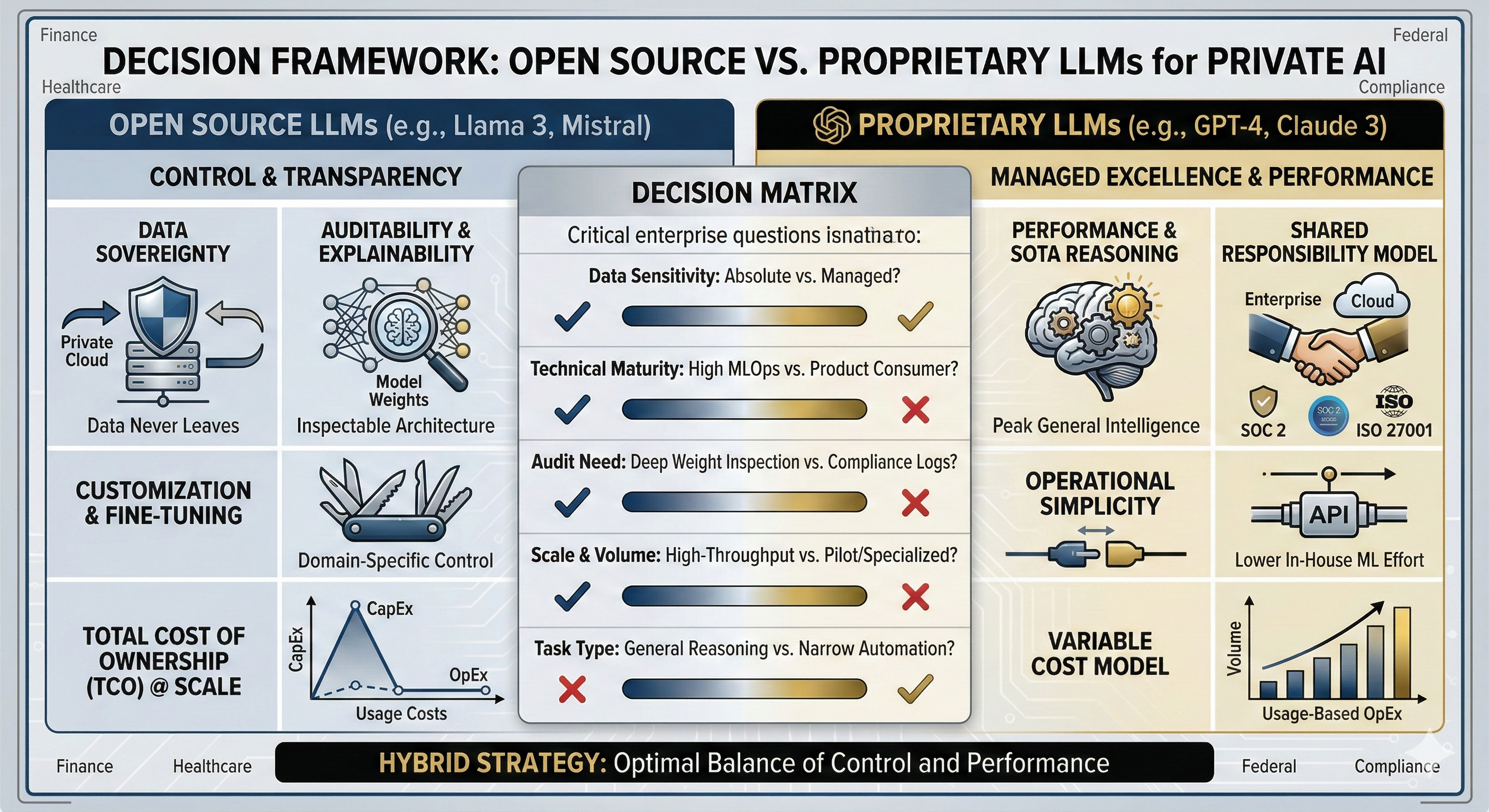
Skip parameter-count wars. For open source LLM vs proprietary choices in regulated environments, compare:
- Data path — does inference ever leave your boundary?
- Change control — who can push weights/prompts/tools into production?
- Auditability — can you reconstruct why an output shipped?
- Operating cost — talent + infra vs vendor lock-in over 3 years
- Exit options — can you replace the model without rewriting the workflow?
Open source LLM stacks win when sovereignty and customization dominate. Proprietary wins when you need managed quality fast and can accept a tighter vendor envelope — still preferably inside a private tenant, not a public consumer API.
Why Open Source vs Proprietary Is the Wrong Question (And What to Ask Instead)
Framing the decision as "open source LLM vs proprietary" implies a binary choice. In practice, the most resilient enterprise architectures are hybrid. The real question is not which model but which control properties does my organization require, and which deployment architecture delivers them?
Consider two scenarios:
- A federal agency processing classified communications needs absolute AI data sovereignty. No data can leave a specific geographic boundary. No third-party vendor can access model inputs or outputs. The question is not "GPT-4 or Llama 3?" The question is "Can we guarantee that no token of input data is ever transmitted to an external endpoint?"
- A regional bank wants to automate commercial loan memo generation. The data is sensitive but not classified. Regulatory requirements demand audit trails and explainability, but the bank lacks a dedicated ML infrastructure team. The question is not about model weights—it is about whether the organization can maintain, monitor, and explain the system over its lifecycle.
Both organizations need private AI. But the architecture that serves each one is fundamentally different. The framework below helps you identify which control dimensions matter most for your context, and then maps those requirements to the right model strategy.
Decision companions: Model choice is only one control layer. Pair this framework with private AI vs public APIs (video) and is locally hosted AI really local? (video) before you call a stack “private” or “sovereign.”
The Four Control Dimensions That Actually Matter
When we advise regulated enterprises on LLM architecture, we evaluate every decision against four control dimensions. These are not theoretical—they map directly to the compliance frameworks that govern financial services (OSFI B-13, OCC guidance, DORA), healthcare (HIPAA, PIPEDA), and government (FedRAMP, CCCS guidance, ITAR).
Data Residency and Sovereignty
This is the non-negotiable starting point for any regulated AI deployment. The question is simple: Where does your data go when it touches the model?
With proprietary API-based LLMs (OpenAI, Anthropic, Google), your prompts and context data are transmitted to infrastructure you do not control. Even with contractual guarantees and data processing agreements, you are trusting a third party's security posture, employee access controls, and incident response processes. For many regulated use cases, that trust model is insufficient.
With an on-premise LLM or a model deployed in your own VPC, data never leaves your boundary. Open source models like Llama 3, Mistral, Qwen, or Command R can be deployed entirely within your infrastructure—air-gapped if necessary.
Key questions to ask:
- Does our regulatory framework permit data transmission to third-party model providers?
- Do we have contractual certainty about where inference occurs geographically?
- Can we demonstrate to auditors that no training data was exposed to external systems?
- Do we need air-gapped deployment capability?
If the answer to questions 3 or 4 is yes, open source models deployed on-premise become the default architecture—not by preference, but by necessity.
Model Customization and Fine-Tuning
General-purpose LLMs are impressive. They are also generic. For enterprise use cases in regulated industries, the difference between a general model and one fine-tuned on your domain-specific data is the difference between a prototype and a production system.
Open source models give you full access to model weights. This means you can:
- Fine-tune on proprietary datasets (loan documents, clinical notes, policy manuals)
- Apply RLHF or DPO to align outputs with your organization's risk tolerance and communication standards
- Distill larger models into smaller, faster variants optimized for specific tasks
- Control the training pipeline end-to-end for reproducibility and auditability
Proprietary platforms offer fine-tuning APIs, but with constraints. You are typically limited to the customization surface the vendor exposes. You cannot inspect the base model weights, you cannot verify what data influenced the base model's behavior, and you cannot guarantee that a model update from the vendor will not change your fine-tuned model's behavior.
For organizations where model behavior must be deterministic and auditable—think algorithmic trading compliance or clinical decision support—this distinction is critical.
Audit and Explainability Rights
Regulators are increasingly asking not just "What did the AI decide?" but "How did it decide, and can you prove it?"
With open source models, you own the full inference stack. You can:
- Log every input, output, and intermediate step
- Implement token-level attribution and attention analysis
- Reproduce any specific output by re-running the same model version with the same input
- Provide regulators with complete model cards, training data provenance, and evaluation metrics
With proprietary models, your audit capability is limited to what the vendor's API returns. If the vendor updates the model—which happens frequently and often without advance notice—your ability to reproduce a prior output may be compromised. This is not a theoretical risk. Multiple enterprises have reported behavioral drift in proprietary models after silent updates, creating compliance gaps in production systems.
A practical example: A Canadian financial institution using AI for anti-money laundering (AML) transaction monitoring must be able to explain to FINTRAC why a specific transaction was flagged or not flagged. If the underlying model changes without the institution's knowledge or control, the entire audit trail becomes unreliable.
Operational Control and Risk
This dimension is where the trade-offs become most honest.
Open source gives you control, but control comes with responsibility. You need:
- Infrastructure to host and serve models (GPU clusters, inference optimization)
- MLOps capability to manage model versioning, monitoring, and rollback
- Security expertise to harden the deployment stack
- Ongoing investment in evaluating new model releases and deciding when to upgrade
Proprietary platforms abstract this complexity. You get an API, an SLA, and a support contract. For organizations without deep ML engineering teams, this operational simplicity is not a luxury—it is a risk mitigation strategy. A poorly maintained open source deployment can be more dangerous than a well-governed proprietary one.
The honest assessment: operational control is only valuable if you have the organizational capability to exercise it.
When Proprietary Makes Sense (Even for Private AI)
Despite the clear control advantages of open source, there are legitimate scenarios where proprietary LLMs are the right choice for regulated enterprises:
- Rapid prototyping and validation. Before committing to an on-premise LLM infrastructure, using proprietary APIs to validate use cases and build organizational confidence in AI is pragmatic. Just ensure no production data touches the prototype.
- Non-sensitive, high-volume tasks. Customer-facing chatbots handling general product inquiries, internal knowledge search over public documentation, or code assistance for development teams may not require the same control posture as core regulatory functions.
- Frontier capability requirements. For some tasks—complex multi-step reasoning, advanced code generation, or multimodal analysis—the largest proprietary models still outperform open source alternatives. If the use case demands frontier performance and the data sensitivity allows it, a proprietary model with strong contractual controls may be appropriate.
- Limited ML engineering capacity. If your organization has two ML engineers and no GPU infrastructure, deploying and maintaining an open source LLM in production is a significant undertaking. A managed proprietary service with enterprise security features (dedicated instances, customer-managed encryption keys, private endpoints) may deliver a better risk-adjusted outcome.
The key principle: choose proprietary deliberately, with documented risk acceptance, not by default.
When Open Source Is Non-Negotiable
For the following scenarios, open source models deployed on controlled infrastructure are not just preferable—they are effectively mandatory:
- Classified or highly restricted data environments. Defense, intelligence, and certain critical infrastructure contexts require air-gapped deployment. Proprietary API models cannot operate in these environments.
- Regulatory regimes requiring full model transparency. The EU AI Act's requirements for high-risk AI systems, including technical documentation and transparency obligations, are far easier to satisfy when you have complete access to model architecture and training methodology.
- Use cases requiring deterministic reproducibility. Any context where you must prove that a specific input produced a specific output at a specific point in time—and reproduce that result—demands version-controlled model artifacts that you own.
- Long-term strategic independence. Organizations building AI into core business processes—underwriting, clinical decision support, policy analysis—cannot afford vendor lock-in. If your competitive advantage depends on AI, the model layer must be something you control.
- Jurisdictional data sovereignty requirements. When regulations mandate that data processing occurs within specific national boundaries and no foreign entity can access the data, AI data sovereignty can only be guaranteed with self-hosted open source models.
The Hidden Advantage: Open Source as Your Competitive Moat
Beyond compliance, there is a strategic argument for open source that most open source LLM vs proprietary analyses overlook.
When you deploy a proprietary model, you are renting capability. Every competitor in your industry can rent the same capability from the same vendor. Your AI-powered loan analysis uses the same model as your competitor's AI-powered loan analysis. The only differentiation is in your prompt engineering and workflow design—a thin and easily replicable advantage.
When you fine-tune an open source model on your proprietary data—decades of underwriting decisions, millions of clinical outcomes, years of policy analysis—you create something no competitor can replicate. The model becomes an institutional asset. Your organization's accumulated expertise, encoded in model weights, becomes a durable competitive advantage.
This is not theoretical. We are seeing early movers in financial services build fine-tuned models for credit risk assessment that outperform general-purpose frontier models on their specific portfolio characteristics. These models are smaller, faster, cheaper to run, and more accurate for their domain—because they encode institutional knowledge that no general model can access.
The organizations that treat enterprise LLM selection as a strategic capability investment, rather than a vendor procurement exercise, will have compounding advantages over the next decade.
Implementation Reality Check
Honesty about implementation complexity is essential. Here is what a realistic private AI deployment timeline looks like for a regulated enterprise choosing the open source path:
Months 1-2: Foundation
- Establish GPU infrastructure (cloud VPC or on-premise)
- Implement security hardening and network isolation
- Deploy inference serving infrastructure (vLLM, TGI, or equivalent)
- Establish model evaluation benchmarks for your domain
Months 2-4: Validation
- Benchmark 2-3 candidate open source models against your use cases
- Develop domain-specific evaluation datasets
- Implement logging, monitoring, and observability
- Begin fine-tuning experiments on non-production data
Months 4-6: Production Readiness
- Complete fine-tuning on production-representative data
- Implement governance controls (access management, audit logging, bias testing)
- Conduct red-team testing and adversarial evaluation
- Complete regulatory documentation and model risk management artifacts
Months 6+: Operational Maturity
- Establish model update and retraining cadence
- Build feedback loops from production usage to model improvement
- Develop internal expertise for ongoing model evaluation and selection
This is not a weekend project. It requires sustained investment in people, infrastructure, and process. But for organizations where control, compliance, and competitive differentiation matter, it is an investment with compounding returns.
A Decision Matrix for LLM Selection
Use the following matrix to guide your enterprise LLM selection process. Score each dimension based on your organization's specific requirements:
| Control Dimension | Proprietary API | Proprietary Dedicated Instance | Open Source (Cloud VPC) | Open Source (On-Premise) |
|---|---|---|---|---|
| Data Residency | Low — data leaves your boundary | Medium — dedicated but vendor-managed | High — your cloud tenant | Highest — your physical infrastructure |
| Model Customization | Limited — API fine-tuning only | Limited — vendor-defined surface | Full — complete weight access | Full — complete weight access |
| Audit & Reproducibility | Low — vendor controls versioning | Medium — some version pinning | High — you control model artifacts | Highest — fully air-gapped reproducibility |
| Operational Simplicity | Highest — fully managed | High — mostly managed | Medium — you manage inference stack | Low — you manage everything |
| Time to Production | Weeks | Weeks to months | Months | Months to quarters |
| ML Team Required | Minimal | Minimal | Moderate (3-5 engineers) | Significant (5-10+ engineers) |
| Regulatory Defensibility | Case-dependent | Good for moderate sensitivity | Strong | Strongest |
How to use this matrix:
- Identify your highest-priority control dimension based on your regulatory environment and use case sensitivity.
- Determine your organizational ML capability honestly.
- Select the deployment model that satisfies your control requirements and that your organization can sustain operationally.
- Document your decision rationale—this documentation itself becomes a governance artifact.
The most common mistake we see is organizations choosing maximum control without the organizational capability to maintain it. An unmaintained, unmonitored open source deployment is not more secure than a well-governed proprietary one. Match your architecture to your capability, then invest in growing that capability over time.
The Bottom Line
The open source LLM vs proprietary decision is not about ideology or cost optimization. For regulated enterprises, it is a governance decision that should be driven by your control requirements, your organizational capability, and your long-term strategic posture.
Start with your regulatory constraints. Map them to the four control dimensions. Assess your operational readiness honestly. Then choose the architecture that you can defend to your board, your regulators, and your customers.
Private AI is not a product you buy. It is a capability you build. The model selection is just the first decision in a long chain of governance, engineering, and organizational choices that determine whether AI becomes a trusted asset or an unmanaged risk.
Next: design systems that can explain every decision — and keep private AI under your control.
Related reading from Llama Research
- Private AI for regulated enterprises vs public APIs
- Digital sovereignty: is locally hosted AI really local?
- Autonomous multi-agent AI platform: inside Project Cortex
See more at llamaresearch.ai or email hello@llamaresearch.ai.