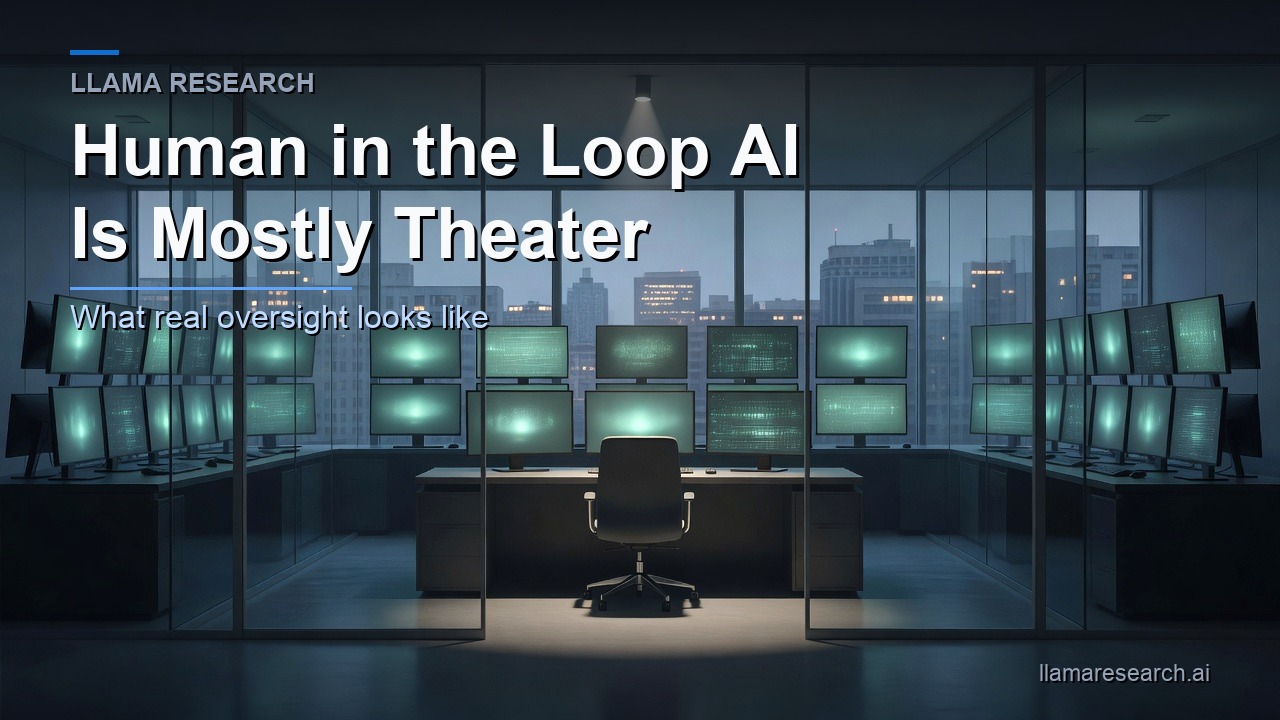
Every enterprise AI vendor will tell you their system includes human in the loop AI (HITL). It's on the slide deck, the compliance checklist, and the RFP response. In most cases, it's theater.
What Is Human-in-the-Loop AI (HITL)?
In the glossary sense, HITL AI means a human remains involved in an automated decision process. Vendors stretch that definition until a dashboard notification counts as “oversight.”
Real human in the loop agent design is stricter: the agent may propose, but a named human must deploy (or refuse) before consequential action executes — with immutable provenance and fail-closed behavior when no approver is available.
A human gets a notification. A human can technically click a button. But if the system has already acted, the workflow has already moved, and the “approval” is retroactive, you do not have control. If you operate in financial services, government, healthcare, or defence, that distinction is liability, not semantics.
This post is about what real human-in-the-loop AI requires, why most implementations fail the test, and how to evaluate your own systems — or your vendor's — this week.
The Theater Problem: Rubber-Stamp Approvals and Fake HITL
Here's how typical "human-in-the-loop" works in the wild:
- An AI agent or automated pipeline makes a decision.
- That decision is logged to a dashboard.
- A human is notified — sometimes in real time, sometimes hours later.
- The human can, in theory, reverse the action.
- In practice they almost never do, because the action already executed.
That is human-near-the-loop, not control. The human observes. They don't gate. When something goes wrong — a bad automated action, a misclassified document, a procurement decision that shouldn't have cleared — the audit trail shows a "human approved" checkbox nobody meaningfully checked.
Regulators are starting to notice. Internal audit already has. If you're building or buying agent systems that touch compliance, procurement, or operational risk, the question isn't whether you have HITL. It's whether your HITL would survive a post-incident review.
What Real Human-in-the-Loop AI Actually Requires
Genuine HITL isn't a UX badge. It's an architecture decision. It shapes how agents are designed, how workflows run, and what the system does when no human is available.
Four properties separate real HITL from theater:
- Agents propose, humans deploy. The AI recommends. A named human authorizes. The action does not execute until that authorization is recorded.
- Veto authority is assigned to named roles, not ambient. Someone specific can say no, and the system treats refusal as a first-class outcome.
- Decision provenance is immutable. Every proposal, approval, rejection, and escalation is logged in a tamper-evident record.
- Refusal-to-act is a valid system state. If no authorized human is available, the system does not default to "proceed anyway." It fails closed.
Propose vs Deploy as a Hard Boundary
The most important design principle in agent oversight is simple: propose, don't deploy.
An agent can analyze data, generate recommendations, draft documents, score risks, and surface options. In a governed environment, it should not execute consequential actions without explicit human authorization.
This isn't about slowing everything down. It's about making the boundary between AI reasoning and organizational commitment explicit and auditable. When a procurement agent recommends a vendor, that's a proposal. When a human signs off and the PO is issued, that's deployment. Those are different events. Record them as different events.
The pattern applies across regulated work:
- Financial services: An agent surfaces a rebalancing recommendation. A portfolio manager reviews and approves before any trade executes.
- Government: An agent drafts a policy brief or flags a compliance gap. A named official reviews before it enters the decision record.
- Healthcare operations: An agent proposes a scheduling optimization. An operations lead confirms before patient-facing changes go live.
The moment you blur "the AI suggested it" and "the organization did it," you've lost the governance thread. You won't get it back during an audit.
Full automation is fine for low-stakes, reversible work — formatting, routine notifications, internal log hygiene. For anything with regulatory, financial, or reputational consequences, the propose-deploy boundary needs to be a hard wall, not a polite suggestion. That same discipline is why fail-closed multi-agent systems matter more than demo polish.
Who Can Veto, and When the Veto Is Non-Negotiable
Real AI governance needs named roles with explicit authority — not "anyone on the team can review," but "this role can veto this class of decisions."
Why that matters:
- Accountability. When something goes wrong, you need to know who could have stopped it and whether they did.
- Escalation clarity. If the primary approver is unavailable, who's next? What's the timeout? What happens if nobody acts?
- Regulatory defensibility. "The team reviewed it" is not an answer. Auditors want who, when, and on what basis.
Your agent system needs a role model: approval authorities tied to decision types. A junior analyst might clear a data-quality flag. A director might be required for client-facing outputs. A C-level role might gate anything above a dollar threshold.
And the part most systems get wrong: the veto must be non-overridable by the AI. If an authorized human says no, the system stops. It doesn't retry, escalate around the human, or queue the action for automatic execution later. It records the refusal and holds.
Refusal-to-act isn't a failure. It's the system working as designed.
What Must Be Logged for Audit and Diligence
Immutable decision provenance is the backbone of trustworthy agent systems. If you can't show an auditor exactly what happened, who was involved, and why, your governance is incomplete.
At minimum, every consequential agent action should produce a record that includes:
- What the agent proposed, including inputs used and the scoring or reasoning applied
- Who was notified and when
- Who approved, rejected, or modified the proposal
- Timestamp and method of that decision (UI click, API call, timeout default)
- Whether the action executed, and the system-level outcome
- Downstream effects triggered by the approval
These logs need to be immutable — append-only, tamper-evident, and stored independently from the system that generated them. If the agent can edit its own audit trail, you don't have an audit trail. You have a story the system is telling you.
For private AI in regulated enterprises, this is doubly important. When models and agents run inside your infrastructure, you control the logging pipeline end to end. That's an advantage only if you actually build the pipeline. A private deployment without decision provenance is just an unaccountable system that happens to run on your hardware.
A Practical Checklist Buyers Can Use This Week
Whether you're evaluating a vendor, reviewing an internal pilot, or stress-testing a live deployment, run these tests now:
The Propose-Deploy Test
Pick a consequential action your AI system can take. Disconnect the human approver. Does the action still execute? If yes, you don't have HITL. You have automation with a notification layer.
The Veto Test
Have an authorized reviewer reject a proposed action. Does the system respect the rejection permanently — or re-queue, retry, or escalate around the human? A real veto is final.
The Ghost Approver Test
Check audit logs for the last 30 days. Can you identify, by name and role, every human who approved a consequential action? If approvals show as "system," "auto-approved," or a generic service account, provenance is broken.
The Timeout Test
What happens when a proposal sits without human action for 4 hours? 24 hours? If the system defaults to execution after a timeout, that's fail-open with a delay — not fail-closed.
The Diligence Team Test
Hand your logs to someone outside the build team — internal audit, legal, compliance, or an external advisor. Ask them to reconstruct one decision chain. If they can't do it in under 30 minutes, the logs aren't doing their job.
These are the questions that show up in regulatory reviews, M&A diligence, and post-incident investigations. Better to find the gaps before someone else does. Pair this with a 30/60/90 ROI measurement framework so "oversight exists" isn't the only success metric on the slide.
How This Maps to Blueprint and Governed Agent Systems
At Llama Research, this is how we build. Blueprint engagements start from the premise that agents in enterprise and government environments need governance designed in at the architecture level — not bolted on after the demo.
That means:
- Propose-deploy boundaries defined during system design, not left to the UI team
- Role-based veto authority modeled as part of the agent workflow
- Decision provenance built into logging and observability from day one
- Fail-closed behavior as the default, not a convenience toggle
It's also why we focus on private AI deployment. When agent systems, models, and decision logs live inside your infrastructure, you keep the governance chain. No third-party platform owns your audit trail. That's not a nice-to-have. For regulated organizations, it's a prerequisite for trust.
If you're building agent systems that need to survive scrutiny — regulators, auditors, your own board — we'd welcome the conversation.
Request a Blueprint consultation →
Related reading
- Anatomy of a Multi-Agent Trading System
- AI Agent ROI: A 30/60/90 Day Measurement Framework That Survives Board Scrutiny
- How to Evaluate Workflows for AI Agents: A Practical Checklist You Can Actually Use
- The Private AI Imperative: Why Regulated Enterprises Are Abandoning Public AI APIs
- Inside Project Cortex: The Autonomous Multi-Agent AI Platform We're Building