When an autonomous trading desk blows up, the postmortem almost never points to a single dumb model. It points to a missing chain of command. Someone didn't check the risk gate. Someone else pushed a config change during a volatility spike. A signal fired, nobody triaged it, and by the time a human noticed, the damage was compounding.
A well-designed multi-agent AI investment trading system architecture doesn't just replace humans with faster code. It replaces the absence of structure with explicit, auditable hierarchy — one where every agent has a defined role, every handoff is logged, and the system's ability to refuse a trade is treated as a first-class feature.
This post walks through that architecture: how CIO, Monitor, and Engineer agents collaborate, disagree, and sometimes shut everything down. If you're evaluating private AI for finance, diligence on autonomous trading platforms, or comparing AI trading agent architecture patterns (data pipeline, risk management, overnight sentinel), this is the anatomy you should be asking to see.
Multi-Agent AI Investment Trading System Architecture
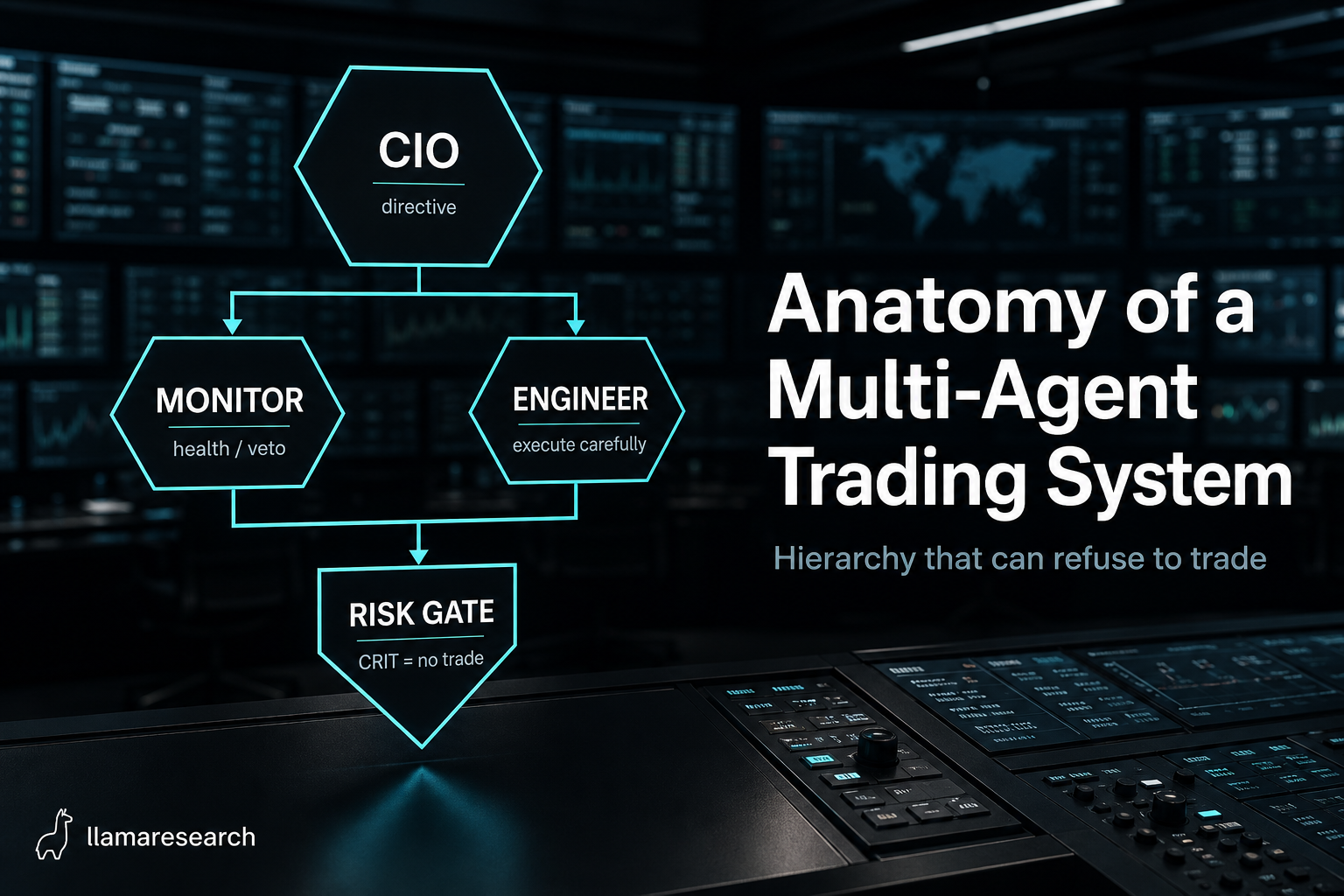
At a glance, the stack is a command hierarchy with hard gates — not a swarm of models trading in parallel:
- CIO agent sets the daily investment boundary (thesis, risk budget, asset-class scope).
- Monitor agent watches infrastructure, data integrity, and peer agents — and can escalate or veto.
- Engineer agent only applies approved infra/config changes when Monitor says conditions are safe.
- Risk gates / CRIT can refuse to trade outright: kill switches, drawdown breaches, reconciliation failures.
That is the difference between a demo bot and an operable multi-agent trading system: refusal paths and provenance are first-class, not afterthoughts.
The Human Trading Desk Had It Right — Until It Didn't
A well-run discretionary desk already has role separation. The CIO sets the macro thesis. Portfolio managers translate that into positions. Risk officers monitor exposure and can pull the plug. Engineers keep the infrastructure alive.
The problem isn't the structure. The problem is that humans are slow, inconsistent, and asleep between 2 and 6 AM. They get fatigued. They defer to authority when they shouldn't. They skip the checklist on the 400th uneventful night.
Autonomous trading agents don't fix this by being smarter. They fix it by being relentless about protocol. The same hierarchy, the same separation of concerns — but executed with machine discipline, 24 hours a day, with every decision written to an immutable log.
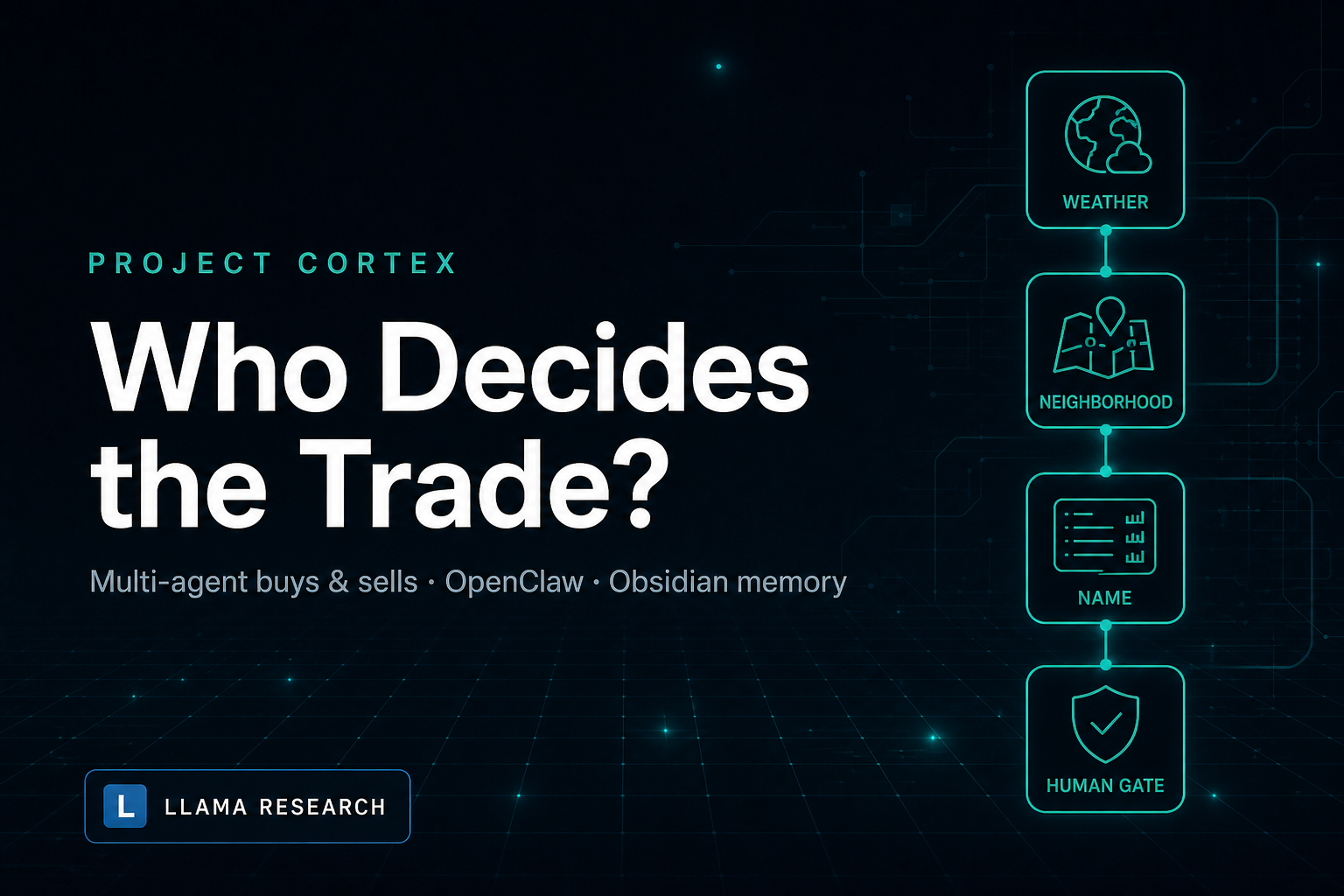
Architecture companion: This desk pattern is the trading-domain expression of the same multi-agent hierarchy we run in production. Watch Project Cortex: autonomous multi-agent AI platform or read the full Cortex write-up. For the control boundary outside the trading book, see private AI for regulated enterprises.
The Agent Desk: CIO, Monitor, Engineer
In architectures like the Project Cortex platform, three agent roles form the operational backbone. Each one maps directly to a function you'd find on a human desk, but with tighter constraints and zero ambiguity about who owns what.
CIO Agent: The Morning Directive
The CIO agent synthesizes overnight data — macro signals, earnings surprises, volatility shifts, sector rotation indicators — and produces a morning directive. Think of it as the daily investment memo, except it's structured, machine-readable, and timestamped.
This directive doesn't execute trades. It sets the boundaries for the day: which asset classes are in play, what the conviction levels are, where the risk budget sits. Downstream agents can act within these boundaries. They cannot act outside them.
The CIO agent's output is the single source of strategic truth for the system. If the directive says "reduce equity beta," no other agent can increase it — regardless of what a real-time signal suggests.
Monitor Agent: Infrastructure Health and Escalation
The Monitor agent doesn't trade. It watches. Continuously.
It tracks broker connectivity (broker API heartbeats, fill latency, order rejection rates), system resource utilization on the always-on orchestrator host, data feed integrity, and position reconciliation. When something deviates from baseline, it generates an escalation_event — a structured alert that gets routed to the appropriate agent or, in critical cases, to a human.
Monitor also watches the other agents. If the Engineer agent is making changes during a high-volatility window, Monitor flags it. If the CIO agent's directive references stale data, Monitor catches the timestamp mismatch.
This is the agent that never sleeps. In overnight sentinel mode, it's the only thing standing between a connectivity dropout and an unhedged position sitting exposed until morning.
Engineer Agent: Careful, Approved Changes Only
The Engineer agent handles infrastructure modifications — restarting services, rotating API keys, adjusting execution parameters, deploying updated model weights. But it doesn't act on its own initiative.
Every change the Engineer agent makes must be pre-approved through a change-control protocol. In practice, this means the Engineer proposes a change, the Monitor agent validates that system conditions are stable enough to proceed, and only then does execution happen. If Monitor says no, the change queues until conditions improve.
This sounds bureaucratic. It is. That's the point. The most dangerous failures in autonomous trading agents aren't bad trades — they're infrastructure changes made at the wrong time.
Handoffs: From Signal to Brief to Directive to Gate to Action
The flow through a multi-agent trading system is deliberately sequential, with explicit gates at each transition.
- Signals arrive from data pipelines — price feeds, news NLP, alternative data scores.
- The CIO agent consumes these signals and produces the morning brief and directive.
- Execution logic (downstream agents or rule engines) interprets the directive into candidate orders.
- Each candidate order passes through AI trading risk gates — position size limits, sector concentration checks, drawdown thresholds, correlation constraints.
- Orders that survive the gates route to the broker. Orders that don't get logged with a rejection reason.
No step is optional. No agent can skip a gate. The handoff chain is the system's immune system.
When Agents Disagree: Why Monitor Can Veto
Here's where it gets interesting. What happens when the CIO directive says "add exposure to energy" but the Monitor agent detects that the broker gateway is showing elevated latency and partial fills?
Monitor vetoes. Full stop.
The architecture gives Monitor override authority on execution-readiness. The CIO sets strategy. Monitor certifies that the infrastructure can safely execute that strategy. If it can't, the system pauses. This isn't a bug or a limitation — it's the most important design decision in the stack.
In human organizations, this kind of veto often gets overridden by seniority. "Just push it through, we'll fix the latency issue later." In a properly governed agent system, the veto is non-negotiable. The log records the disagreement, the rationale, and the resolution. Diligence teams can audit exactly what happened and why.
CRIT and Command-Down: When the System Must Refuse to Trade
Beyond Monitor vetoes, the system supports a CRIT protocol — a command-down escalation that halts all trading activity. CRIT can be triggered by:
- Broker disconnection lasting beyond a configurable threshold
- Position reconciliation failure between internal state and broker state
- Drawdown breach at the portfolio or strategy level
- Data integrity failure (stale prices, missing feeds, NaN propagation)
- Manual kill switch activated by a human operator
When CRIT fires, the system doesn't try to be clever. It cancels open orders, logs the trigger, alerts the human operator, and waits. It does not attempt to "recover" autonomously from a CRIT state.
Refusal-to-trade is a feature, not a failure mode. Any autonomous trading system that can't articulate exactly when and why it will refuse to act is a system that hasn't been designed for real-world operations.
What Diligence Teams Should Ask For
If you're evaluating a multi-agent trading system — whether it's Project Cortex, a proprietary family-office build, or a vendor platform — here's the diligence checklist that matters:
- Full agent interaction logs. Every directive, every escalation_event, every veto, every CRIT trigger. Timestamped, immutable, exportable.
- Decision provenance. For any given trade (or refusal to trade), can you trace back to the signal, the directive, the gate evaluation, and the execution confirmation?
- Shadow mode evidence. Was the system run in paper-first / shadow mode against live market data before any real capital was deployed? For how long? What divergences were observed between shadow and live?
- Broker integration architecture. Is the system using paper trading accounts for validation? How does it handle partial fills, order rejections, and API rate limits?
- Overnight sentinel behavior. What happens between market close and open? What agents are active? What can they do and — more importantly — what can't they do?
- Infrastructure topology. Is this running on a single always-on edge host or a hardened deployment? What's the failover plan? Who gets paged at 3 AM?
Don't accept "we use AI" as an answer to any of these questions. Demand specifics.
AI Trading Agent Architecture vs Demo Multi-Agent Bots
Most public write-ups of a multi agent trading system stop at “agents debate, then trade.” That is useful as a research demo. It is not an operable AI trading agent architecture.
What diligence teams should demand on top of multi-agent chatter:
- Data pipeline integrity — feed freshness, NaN/stale-price handling, broker reconciliation before any order path opens
- Risk management as a gate, not a score — drawdown, exposure, and CRIT conditions that can refuse to trade
- Role separation with veto — Monitor can block Engineer and override reckless CIO-boundary expansion
- Overnight sentinel mode — what runs between sessions, and what is forbidden to run
- Immutable provenance — every directive, escalation, veto, and fill attempt is reconstructable later
If a vendor can only show agents generating signals, they have a chatbot with market data — not a trading desk architecture.
Private Multi-Agent Stacks as Operational Architecture
The real insight here isn't about trading. It's about operations.
A multi-agent trading system, properly built, is an ops architecture — a set of roles, permissions, handoffs, and escalation paths that happen to execute in financial markets. The same patterns apply to any domain where decisions are high-stakes, time-sensitive, and need to be auditable after the fact.
What makes private AI for finance different from a generic cloud-hosted trading bot is control. Your models run on your infrastructure. Your logs stay in your environment. Your risk gates are configured to your risk appetite, not a vendor's defaults. And when something goes wrong at 3 AM, the audit trail is yours to examine — completely, immediately, and without filing a support ticket.
At Llama Research, we build these systems with a simple conviction: the most trustworthy AI system is the one that can explain exactly when it chose not to act. If your current architecture can't do that, we should talk.
Llama Research is a Toronto-based AI consulting firm specializing in private AI deployment, agent systems, and governance for enterprise and institutional clients. We don't sell trading signals or promise returns. We build auditable, secure infrastructure for organizations that need to trust their AI.