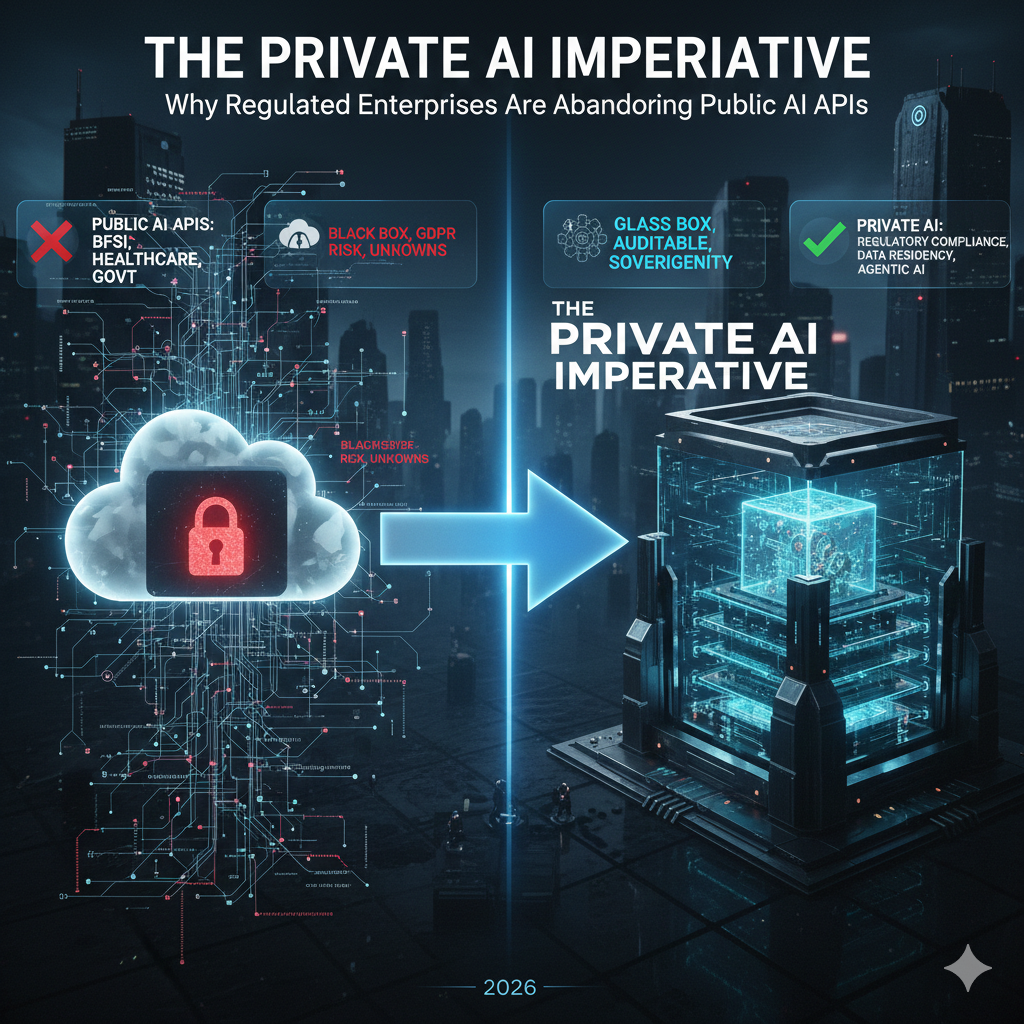
The problem with AI deployments isn't the models. It's that sending regulated data to third-party AI APIs violates data residency, privacy, and security requirements that govern financial services, healthcare, and government — which is why private AI for enterprises has moved from experiment to default.
{{youtube:oXwViXwaHK8|Watch: Private AI for regulated enterprises vs public APIs}}
What Is Private AI for Enterprises?
Private AI means running models on infrastructure you control — your data center, your cloud tenant, your VPC — so prompts, documents, and logs never become someone else's product data. Instead of sending inference to a public API, you host (or tightly tenant) the model yourself. You decide where data lives, who can access it, how long it is retained, and how audits reconstruct a decision.
That is different from a consumer “private chatbot” brand. Enterprise private AI is an operating boundary: residency, subprocessors, breach notification, and model/config change control under your policy — not a vendor privacy page.
This isn't paranoia. It's compliance, cost predictability, and control.
In this article: why public AI APIs fail regulated orgs, when private deployment is non-negotiable, and a practical decision framework.
Next reads if you bounce early: Project Cortex (how we build multi-agent systems) · Anatomy of a multi-agent trading desk · Open source LLM vs proprietary for regulated teams
The Compliance Wall Public APIs Can't Scale
Data Residency Is Non-Negotiable
PIPEDA (Canada's federal privacy law) and Quebec's Law 25 require explicit consent and transparency when personal information crosses borders. If you're using OpenAI's API, your data may touch servers in the US, which falls under the CLOUD Act—giving US law enforcement potential access even to data stored abroad.
For financial institutions, OSFI's B-13 guidelines on technology and cyber risk management explicitly require control over third-party service providers, including data processing locations. You need to know where data is processed, who can access it, and under what legal jurisdiction.
Public AI APIs don't give you that control. Even with their "enterprise" plans, you're trusting:
- Their data handling policies (which can change)
- Their subprocessors and cloud providers
- Their response to government data requests
- Their breach notification timelines
Private deployment solves this: your data never leaves your VPC. You choose the region. You control the audit logs. Compliance becomes a checkbox, not a negotiation.
The Inference-Time Data Problem
Here's what most teams miss: the risk isn't just training data—it's inference data. Every prompt, every document you feed into an AI system, becomes part of the attack surface.
Consider a typical enterprise use case:
- A customer service agent uses an AI assistant to draft a response
- The prompt includes the customer's name, account number, transaction history, and support ticket details
- That data is sent to an external API, processed on shared infrastructure, and logged for model improvement
Even if the vendor promises not to train on your data, you've still transmitted regulated PII across the internet to a third party. That's a compliance failure in most jurisdictions.
With private AI:
- Data stays in your environment
- You control retention policies (ephemeral inference, strict deletion schedules)
- No third-party subprocessors touch your data
- Your security team controls network access and logging
Vendor Lock-In and Predictability
Public APIs are a moving target. Prices change (OpenAI has adjusted pricing multiple times). Rate limits fluctuate. Model versions get deprecated. If your product depends on GPT-4, you're at the mercy of OpenAI's roadmap and pricing strategy.
Private deployment gives you:
- Fixed infrastructure costs (predictable TCO)
- Model stability (you control upgrades and versions)
- No rate limits (scale to your hardware, not vendor quotas)
- Offline capability (air-gapped deployments for classified or highly sensitive environments)
For enterprises running AI in production, predictability is worth more than marginal performance gains.
The 2025 Private AI Stack Is Production-Ready
Two years ago, private deployment meant hiring an ML engineering team, stitching together fragmented tooling, and accepting degraded performance. That's no longer true.
Open Models Have Closed the Gap
Models like Llama 3.1 405B, Mixtral 8x22B, and Qwen 2.5 72B deliver performance comparable to GPT-4 on most enterprise tasks—summarization, extraction, classification, Q&A. You can fine-tune them on your own data, run them on-premise or in your VPC, and pay only for compute.
For specialized tasks (legal document review, clinical note summarization, financial report analysis), fine-tuned smaller models often outperform general-purpose APIs because you control the training data and optimize for your exact use case.
Inference Tooling Is Mature
The infrastructure gap has closed:
- vLLM for high-throughput serving with paged attention
- TensorRT-LLM for optimized NVIDIA inference
- Text Generation Inference (TGI) from Hugging Face for production-grade API serving
- Ollama for lightweight local/edge deployment
These tools are open-source, well-documented, and used in production by Fortune 500 companies. You can deploy a private LLM API in hours, not months.
RAG Pipelines Are Standard Practice
Most enterprise AI applications don't need to retrain models—they need to ground models in internal knowledge. RAG (retrieval-augmented generation) pipelines let you:
- Index internal documents, wikis, databases, and support tickets
- Retrieve relevant context at query time
- Feed that context into a private model for inference
Tools like LlamaIndex, LangChain, and Haystack make this straightforward. You keep your data in your environment, use embeddings for semantic search, and never send proprietary information to an external API.
Cost Benchmarks Show ROI in Months
Let's be specific. A typical enterprise deployment:
ScenarioPublic API Cost (Annual)Private Infrastructure CostBreakeven10M tokens/day (support automation)~$180,000/year (GPT-4 Turbo pricing)$80,000 (8x A100 GPUs + hosting)5-6 months50M tokens/day (document processing)~$900,000/year$200,000 (multi-node cluster)3-4 months100M+ tokens/day (core product feature)$1.8M+/year$400,000 (dedicated infra)3 months
These numbers assume standard API pricing and don't account for:
- Rate limit costs (overage fees)
- Data egress fees
- Engineering time navigating API changes
For high-volume workloads, private AI pays for itself in a single fiscal year.
Still with us? If compliance is settled and you want the operating model — agents, gates, refusal-to-trade — jump to Anatomy of a Multi-Agent Trading System or the build diary Inside Project Cortex.
When Private Deployment Makes Sense (A Decision Framework)
Not every AI use case requires private deployment. Here's how to decide:
✅ Private Deployment Is Non-Negotiable When:
When compliance, scale, or control demands it:
- The data is regulated personal information (PIPEDA, GDPR, HIPAA, FERPA)
- You're in a regulated industry (financial services, healthcare, government, defense)
- Data residency is required by law or contract (Canadian banking, EU data localization)
- You need air-gapped or offline deployment (classified environments, remote operations)
- Usage will exceed 10M tokens/day within 12 months (cost breakeven makes private deployment ROI-positive)
🟡 Hybrid Approaches Work When:
When you can segment sensitive from general workloads:
- You have both public and sensitive data (use APIs for public content, private models for regulated data)
- You're in rapid experimentation mode (prototype with APIs, migrate to private for production)
- You need multiple model sizes (private for high-volume/simple tasks, APIs for occasional complex reasoning)
❌ Public APIs Are Fine When:
When data sensitivity and volume are both low:
- All data is public or non-sensitive (marketing content, public research, generic Q&A)
- Usage is low and unpredictable (internal tools with <1M tokens/month)
- You need cutting-edge capabilities (frontier model performance for non-regulated use cases)
- You lack infrastructure or ML expertise (and don't plan to build it)
What Private Deployment Actually Looks Like
Here's a realistic architecture for a mid-size enterprise (5,000 employees, customer service + document automation use cases):
Infrastructure
- Compute: 4-8 NVIDIA A100 or H100 GPUs (cloud or on-premise)
- Storage: 2-5 TB for models, embeddings, and vector indexes
- Network: Private VPC with API gateway and internal DNS
Model Stack
- Primary model: Llama 3.1 70B (fine-tuned on internal support data)
- Embedding model: BGE or E5 (for RAG retrieval)
- Serving: vLLM or TGI with autoscaling
Data Pipeline
- Ingestion: Internal documents indexed into a vector database (Pinecone, Weaviate, or self-hosted Qdrant)
- Retrieval: Semantic search retrieves top-K relevant docs per query
- Inference: Context + query sent to private LLM, response returned via internal API
- Logging: All requests logged in your SIEM, retained per your data policy
Team Requirements
- 1 ML engineer (model deployment, fine-tuning, monitoring)
- 1 infrastructure engineer (GPU cluster, networking, scaling)
- 1 data engineer (RAG pipeline, embeddings, vector DB)
This is a 3-person team managing AI infrastructure for thousands of users—not the 20-person ML org of 2020.
The Bottom Line
If you're building AI features for a regulated enterprise, the question isn't whether to go private—it's when and how.
Public APIs are a great on-ramp for experimentation, but they're not a long-term solution for organizations that handle sensitive data, require cost predictability, or operate under strict compliance regimes.
The technology has matured. The cost case is proven. The compliance risks of public APIs are well-understood.
Private AI is no longer experimental—it's the default architecture for regulated enterprise AI.
Related reading from Llama Research
- The Digital Sovereignty Trap: Why Locally Hosted AI Isn't Always Local
- Open Source LLM vs Proprietary: Decision Framework for Private AI
- Human in the Loop AI Is Mostly Theater
- Inside Project Cortex: The Autonomous Multi-Agent AI Platform We're Building
- Anatomy of a Multi-Agent Trading System
- Digital Sovereignty: Why Locally Hosted AI Isn't Always Local
What to do next
- See the system in practice — Inside Project Cortex (how Llama Research builds gated multi-agent platforms).
- Go deeper on agent hierarchy — Anatomy of a Multi-Agent Trading System (CIO / Monitor / Engineer + refusal-to-trade).
- Talk architecture — Book a 30-minute private AI review with Llama Research (finance, healthcare, government).
Llama Research helps regulated enterprises deploy private AI they can audit — without shipping sensitive data to public APIs.