There is a comforting narrative in boardrooms and procurement offices: "We host the AI on our own infrastructure, so we're sovereign." Reasonable — and dangerous. Digital sovereignty AI is now a strategic requirement for nations and regulated industries, and the gap between perceived control and actual control is wider than most leaders admit.
{{youtube:oqnTcNCQR1M|Watch: Is locally hosted AI really local?}}
Is Locally Hosted AI Really Local?
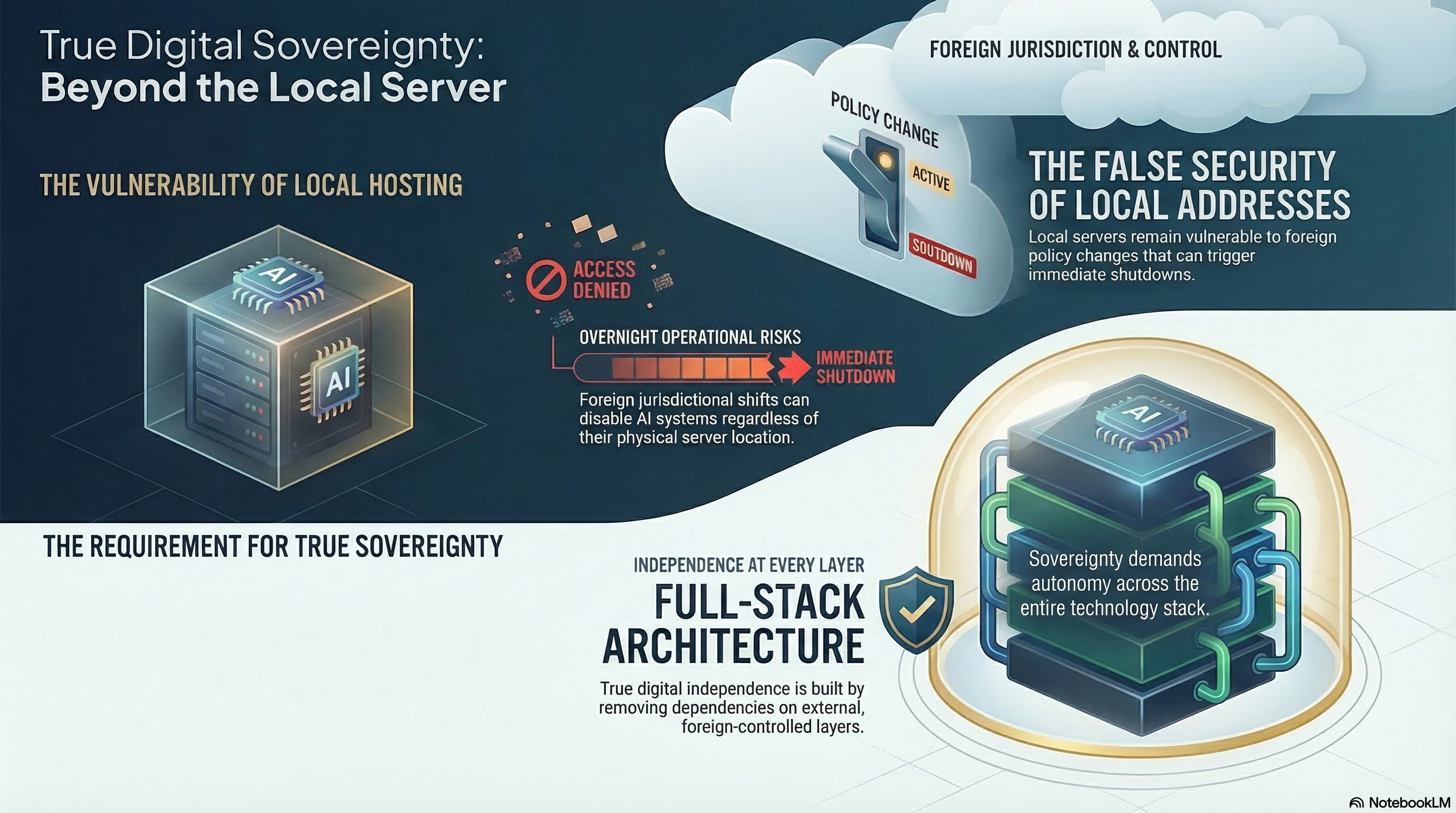
Locally hosted AI can still phone home for licenses, telemetry, model updates, or support tooling. Local hosting is necessary for AI sovereignty — it is not sufficient. CIOs who signed an on-prem deal, CTOs who picked a “local” SKU for compliance, and CDOs who promised the board data never leaves the country all need the same test: can the stack operate without a foreign dependency you cannot replace?
Pair with private AI for enterprises vs public APIs and open source LLM vs proprietary.
What Digital Sovereignty Means in the AI Era
Digital sovereignty, broadly defined, is the ability of an organization or nation to exercise control over its own digital infrastructure, data, and technology decisions without undue dependence on foreign entities. For decades, this conversation centered on data residency — where bytes physically sit. But the rise of AI has fundamentally changed the calculus.
AI systems are not passive databases. They are active decision-making engines that ingest sensitive information, generate strategic insights, and increasingly act autonomously on behalf of organizations. When an AI model advises a central bank on monetary policy, triages patients in a national health system, or processes classified defense intelligence, the question of who truly controls that model becomes a matter of national security — not just IT architecture.
Digital sovereignty AI therefore encompasses far more than data location. It includes:
- Model control: Who built the model, who can modify it, and who can revoke access to it?
- Operational independence: Can the system function without calling home to a foreign server?
- Legal jurisdiction: Whose laws govern the software licenses, terms of service, and intellectual property?
- Supply chain transparency: Do you know every dependency in your AI stack, and can you replace any single one?
When framed this way, it becomes clear that many organizations pursuing local AI deployment have addressed only the most visible layer of a deeply layered problem.
The Hidden Dependencies in 'Local' AI Deployments
The most sophisticated enterprises in the world — banks, defense contractors, government agencies — are making significant investments in on-premises AI infrastructure. They are procuring GPU clusters, standing up private clouds, and negotiating enterprise licenses for commercial AI models. And yet, many of these deployments carry hidden dependencies that could be exploited, revoked, or disrupted by actors outside the organization's control.
API Control and Model Access
Many commercial AI models that are marketed as "deployable on-premises" still maintain a tether to their provider. This tether can take several forms:
- License validation calls: The software periodically contacts an external server to verify that the license is active and valid. If that server becomes unreachable — whether due to a network issue, a sanctions designation, or a deliberate decision by the provider — the model may degrade or cease to function entirely.
- API-gated features: Core capabilities such as fine-tuning, retrieval-augmented generation, or advanced reasoning modes may require API access to the provider's cloud, even when the base model runs locally.
- Metered usage reporting: Some on-premises deployments report usage telemetry back to the vendor for billing or compliance purposes. This creates both a dependency and a potential data exfiltration vector.
The critical question for enterprise AI control is not "Where does the model run?" but rather "Can the model run if the provider disappears tomorrow?"
Software Updates and Security Patches
AI models are not static artifacts. They require ongoing maintenance: security patches for vulnerabilities, updates to address emerging adversarial attacks, alignment corrections, and performance optimizations. In most commercial AI deployments, these updates flow from the model provider.
This creates a subtle but profound dependency. If the provider decides to deprecate a model version, alter its behavior, or restrict updates to certain geographies, the organization is left with a choice between running an increasingly outdated and vulnerable system or migrating to an alternative under time pressure.
For organizations in regulated industries — where model validation and audit trails are mandatory — an unexpected model update can be just as disruptive as a model shutdown. A financial institution that has validated a model for credit risk assessment cannot simply accept a new version without re-running its entire validation suite. Yet refusing the update may mean operating with known security vulnerabilities.
Licensing and Terms of Service
Perhaps the most overlooked dependency is the legal one. Commercial AI models are governed by licensing agreements that can be modified, sometimes unilaterally, by the provider. These agreements typically include:
- Use-case restrictions: Prohibitions on using the model for certain applications (military, surveillance, law enforcement) that may conflict with the organization's mission.
- Geographic restrictions: Clauses that limit deployment to approved jurisdictions, which can change as geopolitical relationships shift.
- Termination provisions: The provider's right to revoke the license under certain conditions, including sanctions compliance, policy violations, or simply a change in business strategy.
An organization that builds critical workflows on a model governed by a foreign provider's terms of service has, in effect, outsourced a portion of its operational decision-making authority to that provider's legal and compliance team. This is the antithesis of AI independence.
Geopolitical Risks That Companies Overlap
The dependencies described above are not merely theoretical. They exist within a geopolitical context that is becoming more volatile, not less. For organizations outside the United States — and increasingly, for organizations within it — the intersection of AI and geopolitics creates risks that traditional IT risk frameworks were never designed to address.
Export Controls and Sanctions
AI technology is increasingly subject to export control regimes. Advanced chips, model weights, and even certain training methodologies are now regulated commodities. When a government imposes new export controls, the effects cascade through the AI supply chain:
- Organizations in targeted countries may lose access to model updates, support, or new model releases.
- Hardware refresh cycles may be disrupted if GPU exports are restricted.
- Cloud-adjacent services (monitoring, orchestration, fine-tuning platforms) may be cut off even if the base model runs locally.
Recent history provides ample precedent. Organizations that built their technology stacks on the assumption that trade relationships would remain stable have been caught off guard when those assumptions proved wrong. In the AI context, the consequences are amplified because AI systems are often embedded in critical decision-making processes that cannot easily be paused or migrated.
Data Residency vs. Data Sovereignty
Many jurisdictions have implemented data residency requirements that mandate certain categories of data must be stored within national borders. Organizations often treat compliance with these requirements as equivalent to data sovereignty. It is not.
Data residency answers the question: Where is the data physically located?
Data sovereignty answers the question: Who has the legal authority to access, compel disclosure of, or restrict the use of that data?
A model running on servers in Frankfurt, operated by a company headquartered in a foreign jurisdiction, may still be subject to that foreign jurisdiction's legal demands for data access. Extraterritorial legislation in several major economies grants domestic authorities the power to compel companies to produce data regardless of where it is stored. For organizations processing sensitive government, healthcare, or financial data, this distinction is not academic — it is existential.
The Jurisdiction of the Provider
The legal domicile of your AI provider determines which government has ultimate leverage over your AI capabilities. This is a risk that compliance officers in non-US markets are increasingly — and rightly — focused on.
Consider the following scenario: A European defense agency deploys a commercial AI model on-premises for intelligence analysis. The model provider is domiciled in a foreign country. A geopolitical crisis emerges in which the interests of the agency's nation and the provider's home country diverge. The provider's government issues a directive restricting the use of its domestic AI technology by foreign military and intelligence organizations.
The agency's "on-premises" AI is now subject to a foreign government's policy decision. The hardware is local. The data is local. But the permission to operate is not.
This is the digital sovereignty trap in its purest form.
When Local Hosting Isn't Enough
Let us be precise about what local hosting does and does not provide:
| What local hosting provides | What local hosting does NOT provide |
|---|---|
| Data residency compliance | Independence from foreign licensing terms |
| Reduced network latency | Protection from export control disruptions |
| Physical security of hardware | Immunity from extraterritorial legal demands |
| Some reduction in attack surface | Guaranteed continuity of model access |
| Audit trail for data access | Control over model behavior and updates |
For organizations in regulated industries — financial services firms subject to operational resilience requirements, healthcare systems bound by patient data regulations, government agencies handling classified information — the right column represents an unacceptable set of residual risks.
The lesson is not that on-premises AI is without value. It is a critical foundation. But it is only the first layer of a true AI sovereignty strategy. Without addressing the legal, operational, and supply chain dependencies, local hosting creates a false sense of security that may be worse than no sovereignty strategy at all — because it discourages organizations from asking the harder questions.
What True AI Sovereignty Looks Like
Achieving genuine digital sovereignty AI requires a holistic approach that addresses dependencies at every layer. Here is what that looks like in practice.
Open-Weight Models
The single most impactful step an organization can take toward AI independence is to adopt open-weight models — models whose parameters are publicly available and can be downloaded, deployed, modified, and maintained without any ongoing relationship with the original developer.
Open-weight models provide:
- No license revocation risk: Once you have the weights, no one can take them away.
- No API dependency: The model runs entirely on your infrastructure with no call-home requirement.
- Full auditability: Your security and compliance teams can inspect the model at the parameter level.
- Customization freedom: You can fine-tune the model on your own data for your specific use cases without restriction.
- Vendor independence: If the original developer ceases to exist, changes their business model, or becomes subject to sanctions, your operations continue uninterrupted.
The open-weight ecosystem has matured dramatically. Models competitive with the best commercial offerings are now available under permissive licenses, with active communities providing ongoing improvements, security research, and tooling.
Independent Infrastructure
True local AI deployment means controlling the full infrastructure stack:
Compute GPU and accelerator hardware that you own or lease under terms that cannot be unilaterally revoked. Diversify hardware vendors to reduce single-supplier risk.
Orchestration Use open-source orchestration and serving frameworks rather than proprietary platforms that may carry their own licensing dependencies.
Data pipelines Ensure that your data ingestion, preprocessing, and retrieval-augmented generation pipelines run entirely within your controlled environment.
Monitoring and observability Deploy open-source monitoring tools rather than vendor-provided dashboards that may transmit telemetry externally.
The goal is a deployment that can operate indefinitely in an air-gapped environment if necessary — even if it normally operates with network connectivity.
Transparent Supply Chains
Just as manufacturing organizations audit their physical supply chains, organizations pursuing AI sovereignty must audit their AI supply chains:
- Model provenance: Where was the model trained? On what data? Under what legal framework?
- Dependency mapping: What software libraries, frameworks, and tools does your AI stack depend on? What are their licenses? Where are their maintainers located?
- Hardware provenance: Where were your accelerators manufactured? Are they subject to export controls that could affect replacement or repair?
- Personnel dependencies: Does your team have the skills to maintain and fine-tune your AI systems independently, or are you dependent on the vendor's professional services?
A transparent supply chain does not mean eliminating all foreign components — that is neither practical nor desirable. It means understanding every dependency so that you can make informed risk decisions and develop contingency plans for disruptions.
Questions to Ask Your AI Provider
For CIOs, CTOs, and compliance officers evaluating AI deployments, here are the questions that separate genuine enterprise AI control from the illusion of it:
1. If your company ceased to exist tomorrow, would our AI systems continue to function indefinitely?
If the answer involves any caveats about license servers, API endpoints, or support contracts, you have a dependency.
2. Under what legal jurisdiction are our licensing terms governed, and what extraterritorial laws could affect our deployment?
If your legal team cannot answer this question with confidence, you have a gap.
3. Can we fine-tune, modify, and redistribute the model without your permission?
If not, your ability to adapt the AI to your evolving needs is contingent on the provider's ongoing cooperation.
4. What telemetry does the software transmit, to whom, and under what circumstances?
Any external data transmission — even metadata — is a potential sovereignty and security concern.
5. Are there any use-case restrictions in the license that could conflict with our current or future operations?
Restrictions that seem irrelevant today may become critical as your AI applications expand.
6. What happens to our deployment if your home government imposes export controls that affect our jurisdiction?
The provider may not be able to answer this honestly, which is itself an answer.
7. Can we operate the system entirely air-gapped with no degradation in functionality?
This is the ultimate test of operational independence.
8. Do we have access to the model weights, and can we migrate to alternative infrastructure without your involvement?
Portability is sovereignty. Lock-in is dependency.
If your provider cannot give clear, unqualified affirmative answers to these questions, your "local" deployment may be local in name only.
The Path Forward
The pursuit of digital sovereignty AI is not about technological isolationism. It is about informed, deliberate control over the AI systems that increasingly drive critical decisions in finance, healthcare, defense, and public administration. It is about ensuring that the intelligence your organization depends on cannot be degraded, revoked, or compromised by decisions made in a foreign boardroom or government office.
The organizations that will navigate the coming decade most successfully are those that treat AI sovereignty not as a checkbox — "Yes, it's hosted locally" — but as a continuous discipline that spans technology, law, geopolitics, and organizational capability.
The good news is that the tools for genuine AI independence exist today. Open-weight models, open-source infrastructure, and a growing ecosystem of providers committed to transparent, sovereign AI deployment have made it possible to build AI systems that are truly yours — not rented, not licensed, not contingent on someone else's permission.
The question is not whether your organization can afford to pursue true AI sovereignty. In an increasingly fractured geopolitical landscape, the question is whether you can afford not to.
Llama Research helps enterprises and government organizations deploy private, sovereign AI systems built on open-weight models and independent infrastructure. If the questions in this article gave you pause, we should talk.
Related reading from Llama Research
- Private AI for regulated enterprises vs public APIs
- Open source LLM vs proprietary for regulated AI
- Autonomous multi-agent AI platform: inside Project Cortex
See more at llamaresearch.ai or email hello@llamaresearch.ai.