Llama Research runs a decision algorithm that has to keep earning its place.
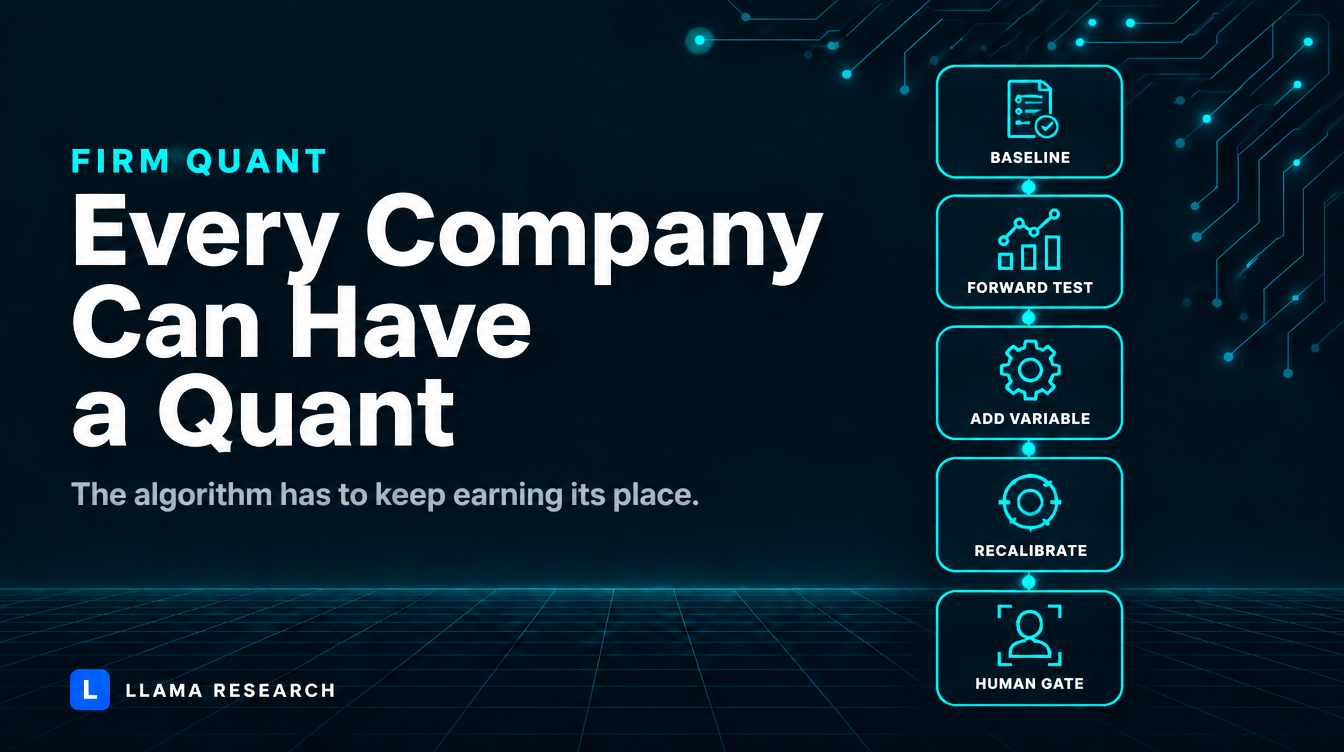
We do not ask an AI to pick winners and sound sure. We run a rule on days it has not seen, keep it only if it holds a flat baseline, and keep changing it only when a new variable actually moves the result. When the live rule fails, it recalibrates. A worse version does not replace a better one.
That loop is running now. It is our quant. Trading on the S&P 500 is just the cleanest scoreboard. The same job exists anywhere a firm already has a repeated decision and a record of what happened next.
The decision algorithm has to keep earning its place
Most AI projects fail for a boring reason we have written about before: nobody checks whether the system is measuring the right thing. A model can look busy and still be guessing.
A decision algorithm is the opposite of that. It has one job — attach odds to a decision you already own — and it is not finished when the first version ships. It has to keep beating a simple guess on new days. If it cannot, we say so, and we do not pretend confidence.
That is what we mean by a continuously improving algorithm. Not a model that retrains because the calendar said so. A rule that is allowed to change only when the evidence says the change helped.
Forward testing on the S&P 500
We prove the method on public tape. The universe is the S&P 500. The test that matters is forward testing: run the algorithm on days the rule has not seen yet. A prettier backtest is not a result.
The first win is a flat baseline. Do no worse than a simple "do nothing special" guess. That is the floor. Everything after that has to beat that floor on new data.
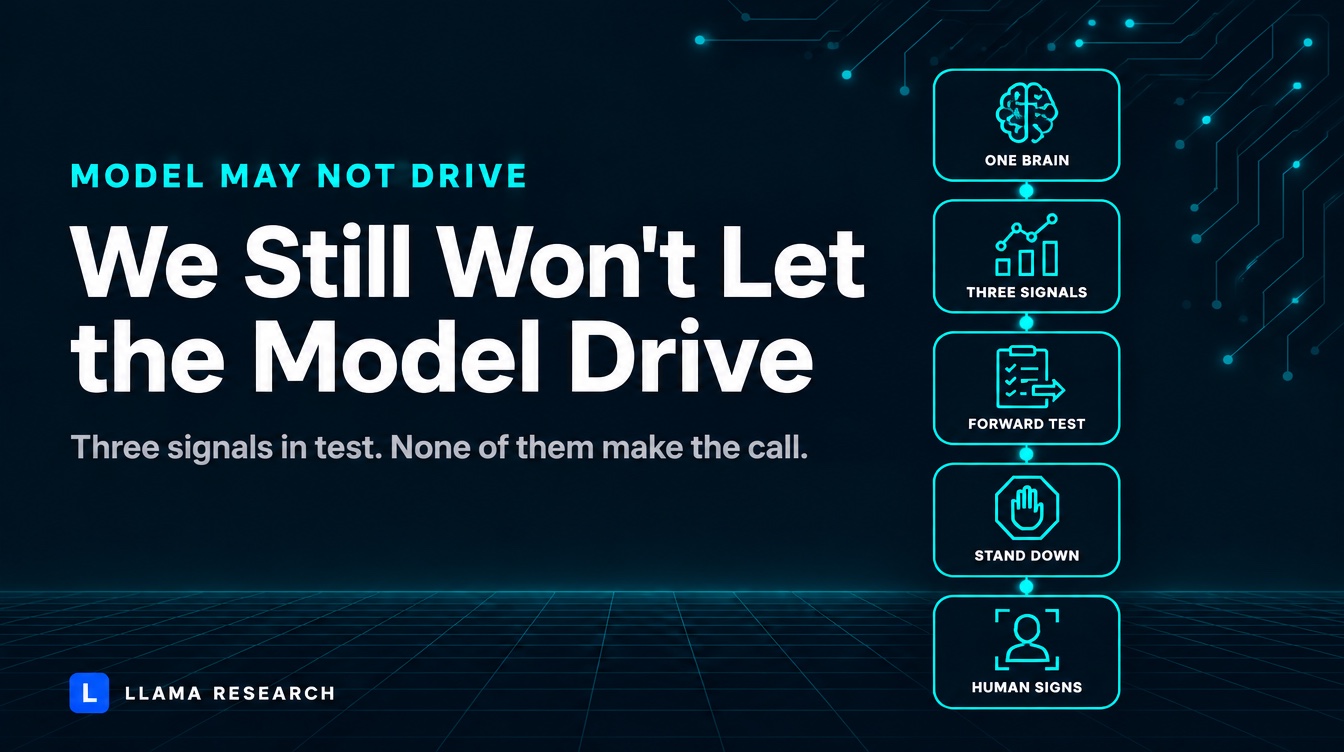
We have already learned this the hard way. We built one model to rank the whole market. It died. The next versions stay in test. None of them is allowed to take the trade. The signal engine can be working and still not drive.
A 24/7 agent team that only adds what works
Improvement is not a quarterly workshop. A team of private AI agents works around the clock as researchers, not traders.
They hunt edge cases. They try a new variable. They measure whether it actually moved the result on forward-tested days. If it did, we add it. If it did not, it stays out. One variable at a time, so when something goes wrong we can say which change did it.
That is the same discipline we use when a company starts building its own agents. The agents propose. A person still owns what goes into the live rule. The model does not get to promote itself.
When the algorithm fails, it recalibrates
Things change. A variable dies. A regime shifts. Accuracy fades. If you wait for a committee, you are running last quarter's rule on this quarter's tape.
When the live algorithm fails, it recalibrates against the same baseline. The new version has to earn the seat on unseen days. If it cannot beat the old one, the old one stays.
That is automatic in the research loop. It is not a free pass to act. Recalibration updates the odds. It does not spend the money.
A firm's quant is a job, not a ticker
Trading is only the cleanest version of this, because the market scores you every day. The transferable thing is the job.
A firm's quant is the function that keeps one repeated decision honest:
- what you decided
- what happened next
- a flat baseline
- a test on days you have not seen
- a crew that only adds a variable when it moves the result
- a recalibration when the live rule fails
Point that desk at another book and the algorithm is still a decision algorithm. Only the question changes.
- Credit — did this loan go bad
- Payments — was this decline real fraud
- Insurance — was this claim real
- Inventory — did this SKU actually stock out
- Pricing — did the new number win the job, or just lose the margin
An algorithmic economy is already here: prices, limits, and allocations that software moves. The missing piece in most firms is not another chatbot. It is a quant that can show its work.
A test case on proprietary data
We do not import the S&P 500 rule into a client's shop. We start with one test case and the proprietary data they already have — the decision, and what happened after.
Most companies have the first part. Almost nobody keeps the second. That is why the first week is a check, not a build. If the book can support a baseline on unseen days, we build their algorithm. Unique because the records are unique. If the book cannot support it, we say so, and they do not pay for the next phase.
The file stays on their side of the line. That is private AI as an operating boundary, not a brand name.
Private agents decide from odds, not a guess
Then a private agent is allowed to use the algorithm. It is not "more confident" because the prose sounds sure. It is more confident because the odds came from their history, were forward-tested, and get recalibrated when the live rule fails.
The agent still does not get a free hand. When someone asks why, "the model said so" is not an answer. The answer is the baseline, the holdout, the variable you added, and the person who let that version go live.
What is working today
Llama Research runs this loop on public tape, on our own system. Forward testing. Flat baseline. Agents researching edge cases around the clock. Variables added only when they earn it. Automatic recalibration when the live rule fails.
That is the kitchen. The client work is the same kitchen on a private book: a test case, a unique decision algorithm if the records can support one, and private agents that act on odds that belong to the firm.
The market work is how we keep the method honest. The paid work is installing the same quant function on a decision they already own. The continuously improving algorithm is what both are for — and it is already at work.
If you have a repeated decision and the records of what happened next, we can tell you whether a firm quant has anything to stand on. That conversation starts with the data you already have, not a demo.