01
Blueprint
Diagnose and prioritize. Decide where AI will earn its place, which controls it needs, and what happens first.
Llama Research builds AI that works on your own data, inside your own walls, and leaves a record of every decision — so someone can explain it afterward to an auditor, a regulator, or your board.
Start here. We talk through the problem you already have. Then you get a plan: where AI will help, where it should not be trusted, and what to do in the first 90 days.
We start with how the business actually runs: who decides what, what has to be checked, and the result you expect to see. AI helps people decide. People stay accountable for the decisions that matter.
Diagnose and prioritize. Decide where AI will earn its place, which controls it needs, and what happens first.
Build and deploy. Private systems, agents that can take action but only inside your rules, and the change in how your team works to run them.
Run, measure, and retrain. Results feed back in, every update is retested before it goes live, and accuracy is tracked as things change.
Powered by Cortex — trusted data, decision logic, governance, and accuracy that gets re-checked, not assumed.
Every system is described the same way: what was stuck, what the system was allowed to see, what it recommended, who had to approve, and what changed.
Fragmented signals. No owner for the decision. Too slow to explain after the fact.
Trusted company data, with access limited to what that decision is allowed to use.
A recommendation with confidence, assumptions, and the boundary it must stay inside.
A named approval path. If the gate is not met, the action does not proceed.
Cycle time, quality, or visibility — reported only when the result is approved to share.
Project Cortex is Llama Research's own multi-agent decision platform. It runs on ten agents — small programs that each watch one thing and propose an action, but can never take one without a person saying yes. They work across more than forty scheduled jobs. The prediction model retrains every night, and if the new version cannot be verified, the old one stays in place. Uptime has held above 99% since our infrastructure migration. All of it runs on real logic, real infrastructure, and real data, in a simulated environment, so nothing is at risk while we validate it.
Any gate can stop a decision cold. Missing data means the system stands down rather than taking a free pass.
AI sounds confident even when it is wrong. So when a decision has a right answer — did the customer leave, was the invoice disputed, was the alert real — we do not leave it to the AI's opinion. We build a separate system alongside it: a prediction model trained on your own history of what you decided and what happened next. Not a chatbot, and not the AI learning to write better. This is the oldest, best-understood part of machine learning — find the pattern in your own numbers, then check it against what actually happened. The AI keeps reading the documents and explaining the result. The prediction model supplies the odds, and we can tell you how often those odds have been right.
We gather your past decisions and what happened after each one. Most companies have the first part. Almost nobody keeps the second.
The prediction model learns the pattern, then we test it on months it has never seen. The accuracy we quote is the accuracy you get.
Things change and accuracy fades. We retrain and retest on a schedule. If a new version cannot beat the old one, the old one stays.
We start with a short check on your data. One question decides most of it: do you have records of what happened after each decision, not just the decision? You get one of three answers — there is something here and this is how strong it is, there is something here once the records are cleaned up, or there is nothing here worth building. We tell you the price before any work starts.
Built on your data, runs in your environment, re-checked in Orbit.
It runs where your data is allowed to live, with the access rules and security your organization already requires.
Who approves what, what gets logged, and when a human is pulled in are built in from day one — not added after an audit.
The output lands in the tools your team already uses, and changes something you can measure.
The people running your engagement have had to answer for results themselves, not just advise on them.
Most of what gets published about AI is a success story. These are the problems we hit building our own systems, and what we changed afterward.
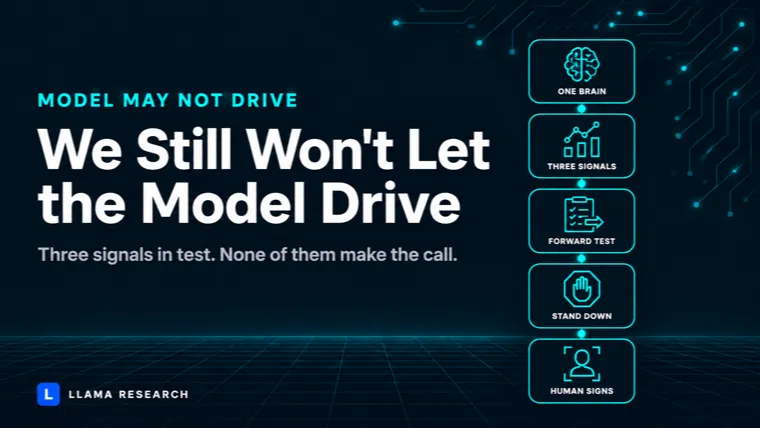
We built one model to rank the whole market. It died. Three ideas are in test now, and none of them is allowed to make the call.
A fraud system that caught more fraud than the old rules still failed its audit, because nobody could explain one Tuesday’s decision.
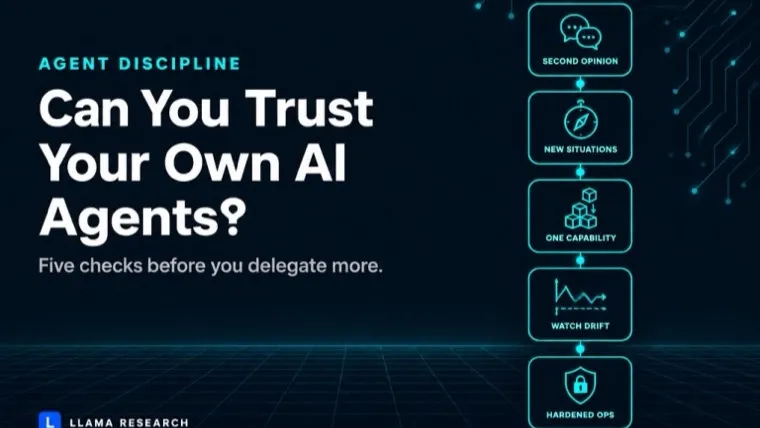
The dangerous agent is not the one that crashes. It is the one that looks like it is working while chasing the wrong measure.
Before Llama Research, the same two operators built and ran payments infrastructure in regulated markets — securing licenses, passing audits, and owning the consequences when something broke.
A MasterCard-certified digital payments platform, built and scaled across Canada, the UK, and Morocco through to acquisition.
Secured the Bahamas' first Central Bank payment service provider license and MasterCard principal membership. Integrated the world's first CBDC and processed $140M in government disbursements.
A stablecoin payments platform with custodial wallets, Visa card issuance, and AI-powered KYC, serving 200,000+ users across Latin America and the Caribbean.
This is operating history, not client results. Client engagements are described only with approval.
It starts with a conversation about what is actually stuck, and ends with a plan for one process someone already owns: what AI will do, what it may not do, and what changes in 90 days.