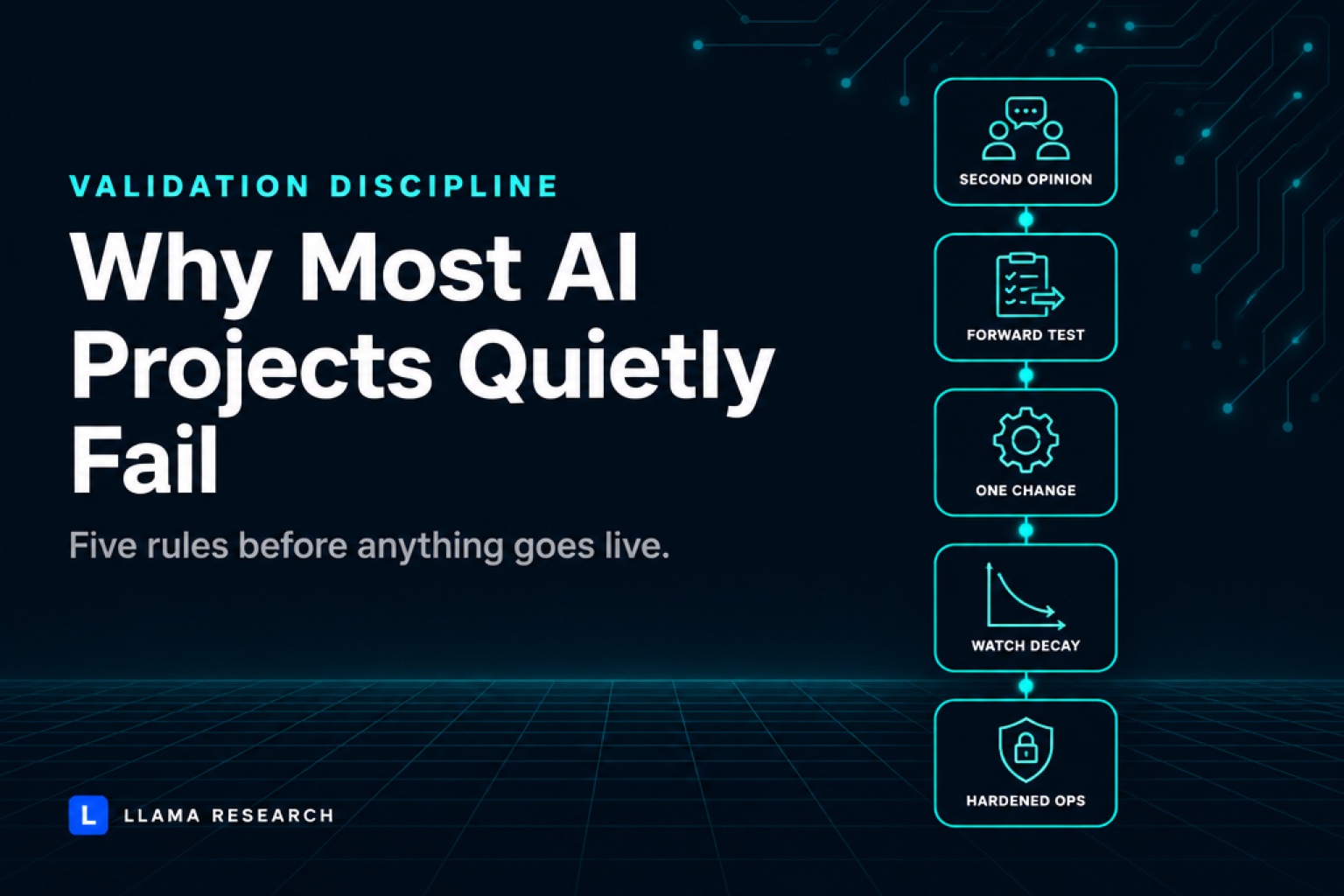
In a previous post, we talked about why most AI projects quietly fail — not because the technology is bad, but because nobody checks whether the AI is actually measuring the right thing. That problem gets more serious, not less, the moment a company starts building its own AI agents to do real work.
Here's why.
The Risk Isn't That an Agent Fails Obviously
When a company deploys its own AI agent — to handle customer requests, flag risks, draft recommendations, make operational decisions — the dangerous failure mode isn't the agent crashing or giving an obviously wrong answer. It's the agent that looks like it's working. Confident outputs. Good test scores. Smooth demos.
And then, quietly, it's optimizing for the wrong thing — and nobody notices until it's already made a hundred small bad calls.
This is exactly the same problem we described with prediction models: a system can score well on the metric it was built to chase while completely missing the outcome that actually matters to the business. An agent is no different. It just makes the problem more visible, because an agent isn't producing one prediction — it's making ongoing decisions, over and over, often with less direct human review of each individual action.
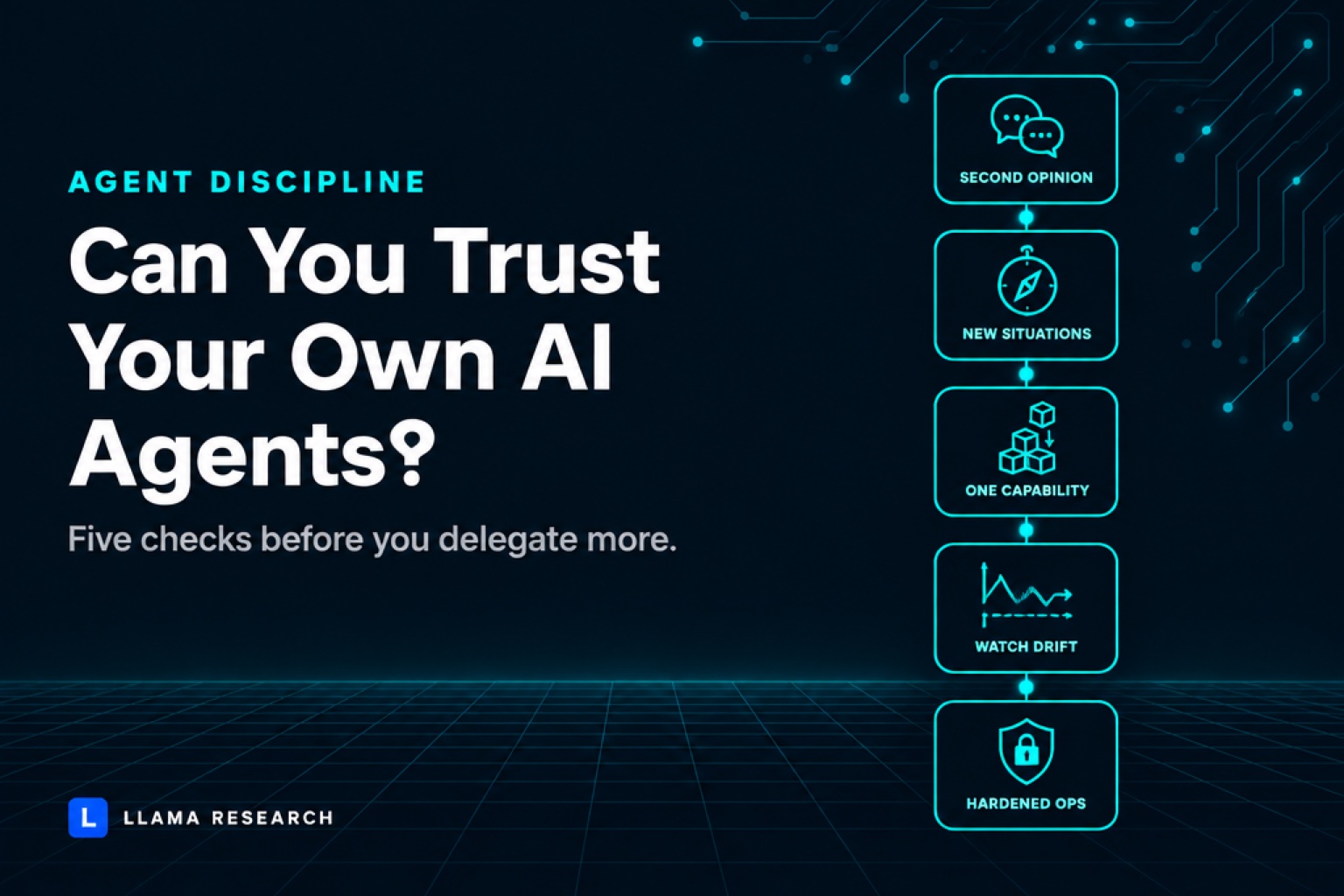
Five Things That Make an Agent Team Actually Trustworthy
The same five disciplines we use for predictive models apply directly — arguably more urgently — to a company's own AI agents.
1. A second opinion, built into the process. Whatever an agent decides is its "best" action, there has to be an independent check on whether that action actually serves the business outcome — not just whether the agent is confident about it. Without this, you're trusting the agent's own judgment of itself.
2. Proof on new situations, not just training scenarios. An agent that looks great handling the cases it was built and tested on can still fail the moment it meets a slightly different real-world situation. Before an agent gets trusted with more responsibility, it needs to prove itself on genuinely new, unscripted situations — not just the ones it was designed around.
3. One capability at a time. When a company expands what an agent is allowed to do, the temptation is to add several new capabilities at once. That's how teams end up unable to explain why something went wrong — too many moving parts changed together. Adding capability one step at a time, and measuring the effect of each step on its own, is what keeps an agent's behavior explainable as it grows.
4. Ongoing monitoring for drift. An agent's good behavior today doesn't guarantee good behavior in three months. Business conditions change, the data it sees changes, edge cases emerge. Automatic monitoring that flags when an agent's decisions start drifting from expected patterns is what catches this before a client or a compliance review does.
5. Infrastructure that doesn't fail silently. An agent is only as reliable as the systems underneath it — the tools it calls, the data it reads, the logging that records what it did. If any of that fails quietly, the agent keeps running, but nobody can trust what it's been doing. The same operational rigor that keeps a prediction pipeline honest is what keeps an agent team honest.
Why This Matters More for Agents Than for Models
A predictive model makes one kind of decision, usually with a human reviewing the output before it's acted on. An agent often makes many decisions, across many situations, sometimes with less direct oversight of each individual action — because the whole point of an agent is to reduce how much a human has to personally review.
That's exactly why the discipline matters more here, not less. The less a human is directly checking each individual decision, the more the process around the agent has to be trustworthy — logged, auditable, independently checked, continuously monitored — because the safety net has moved from "a person looks at every output" to "the system itself is built to catch its own failures."
What This Means for a Company Building Its Own Agent Team
This is the real test of whether a company can safely delegate more to its AI agents over time: not whether the agent is impressive in a demo, but whether there's a real process behind it that lets the team trust it a little more each time it proves itself — and catches it quickly the moment it doesn't.
Companies that skip this discipline tend to land in one of two places: they keep their agents locked down to trivial tasks indefinitely, afraid to trust them with anything real — or they let an agent run with too much authority too fast, and get burned once in a way that sets the whole initiative back.
The middle path — the one that actually works — is a track record. Independent checks before anything goes live. One capability added at a time. Monitoring that catches drift early. A person signing off before an agent's authority expands. That's not caution for its own sake. It's the actual mechanism that lets a company's AI agents become genuinely useful, rather than either useless or unsafe.
If you're building your own agent team and want a second opinion on whether the discipline behind it would hold up, we'd like to talk about it.